The contenders
Side by side
- Illustrative photo

The closer-focusing one
Vortex Crossfire HD 8x42 Binocular
Binoculars8.9out of 10Focuses at 6.0 ft and ships with a chest harness, so a bird that steps in close is still readable.
Check price on Amazon#ad · Price set by Amazon · Disclosure for the link to Vortex Crossfire HD 8x42 Binocular
- Illustrative photo
The lighter, better-guaranteed one
Leupold BX-1 McKenzie HD 8x42mm Binocular
Binoculars8.4out of 1022 oz with a guarantee Leupold honors with no receipt, no time limit and no proof you bought it new.
Check price on Amazon#ad · Price set by Amazon · Disclosure for the link to Leupold BX-1 McKenzie HD 8x42mm Binocular
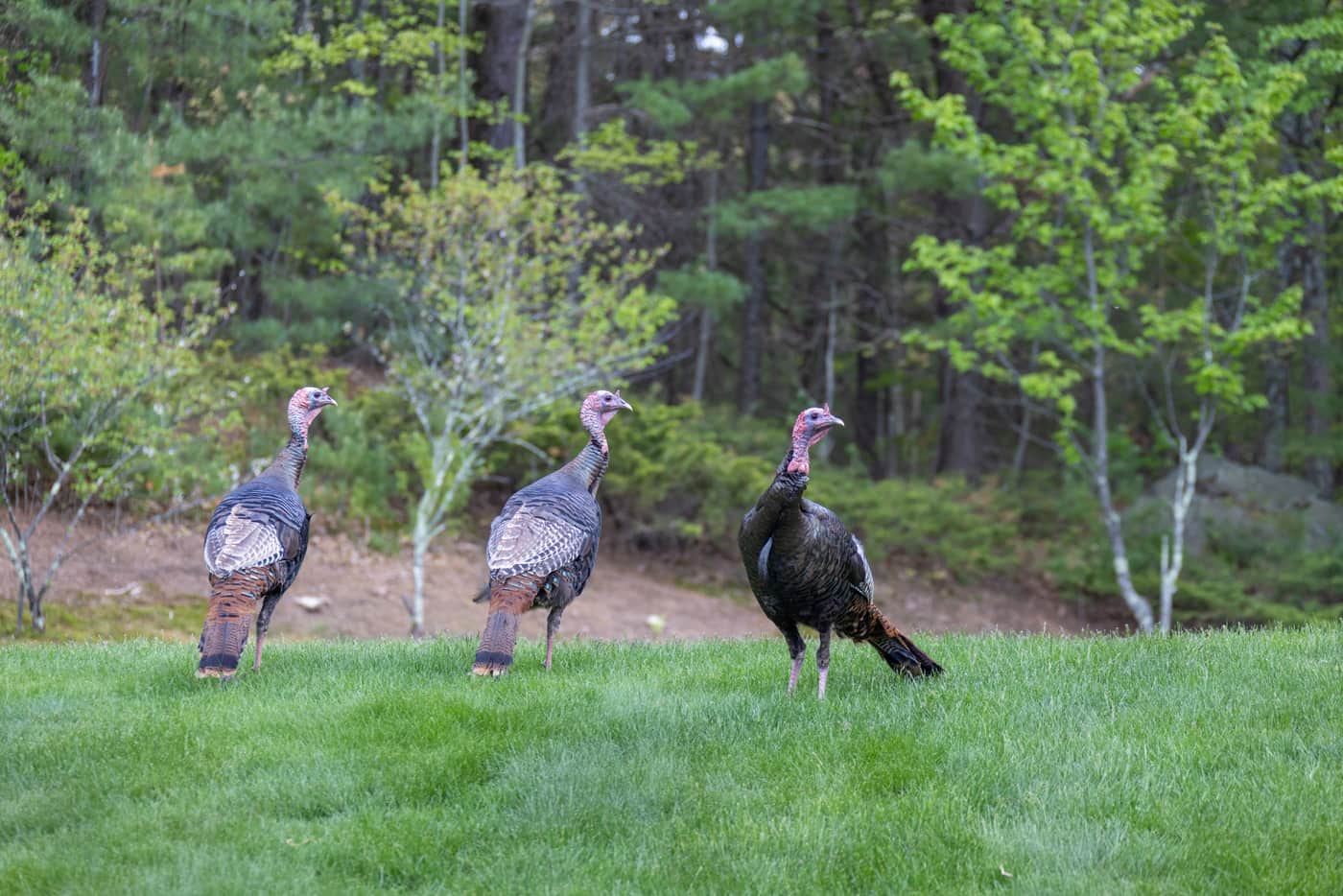
The short version
Identification is the step of a turkey hunt that has to be right every time, and it is the reason the first season hub puts this page before the shooting pages. The NWTF's history of turkey hunting safety work reports that “most incidents were due to mistaken target identification.” Everything below is a field mark published by the NWTF or a state wildlife agency, not a rule of thumb we invented.
Jake vs tom vs hen at a glance
Every figure below is published by the source named under the table. Where two agencies word the same mark differently, both wordings are in the sections that follow.
| Field mark | Jake (young male) | Tom (adult male) | Hen (female) |
|---|---|---|---|
| Age | “Under 2 years in age” (NWTF) | Adult plumage at about 17 to 18 months (NWTF) | Any age |
| Beard | “2 to 5 inches or so” (NWTF) | “Typically” long (NWTF) | Usually none; about 10 percent carry a thinner, shorter one (Maine, PGC, NWTF) |
| Spurs | “Buttons or blunted spurs less than a half inch” (NWTF) | Legs longer than a hen's and “equipped with spurs” (Maine) | “Usually, hens have neither spurs nor beards” (PGC) |
| Head and neck | The male mark: bare and colored | “Bare and blue with a hint of pink and red” (Maine); red, white and blue (NWTF) | “Fine feathers on the back of its neck and head” (PGC) |
| Weight | Not published separately by age | “Adult toms between 10 - 20 lb.” (Maine) | “Average adult hens weigh between 8 - 12 lb.” (Maine) |
| Breast feather tips | The male mark: black | “Tipped with a sharp band of black” (Maine) | “Buff or brown tipped” (Maine) |
| Tail fan | “Middle tail feathers… longer than the others” (PGC, NWTF) | Middle feathers even with the rest | Strutting is described as male behavior (NWTF) |
| Color | The male mark: dark with a sheen | “Closer to black” with “a more vibrant sheen” (NWTF) | “Generally more brown” (NWTF); “smaller and less iridescent” (MDC) |
The beard
The beard is the mark most hunters look for first and the one that misleads them most. On a jake, the NWTF's Ask Dr. Tom column on the jake transition gives beards “ranging from 2 to 5 inches or so in length.” On an adult male, the NWTF's ABCs of hunting wild turkeys says the nickname does the describing: “longbeard refers to an adult male turkey and as the name implies, adult males typically have long beards.”
The trap is that a beard does not prove a male bird. Maine's wild turkey species page records that beards “may be present on about 10% of the hens; however, they are thinner and shorter,” and the Pennsylvania Game Commission's wild turkey page puts it at “on average, ten percent of adult hens have beards; a much smaller percentage has spurs.” A beard is one point of identification. It is never the only one you use.
The spurs
Spurs age a male bird better than a beard does, though you will rarely see them clearly on a walking turkey. The NWTF describes a jake's spurs as “simple buttons or blunted spurs less than a half inch in length.” Maine notes that the “legs of toms are longer than the hens and are equipped with spurs,” and Pennsylvania records that hens usually have neither spurs nor beards.
In practice, spurs are a mark you confirm after the shot rather than before it. On a strutting bird the legs are mostly hidden, and a spur under half an inch is not something to bet a season on at 40 yards.
The head and neck
This is the fastest mark in the woods, because it works at distance and it does not depend on the bird holding still. Missouri's wild turkey field guide describes adult males as “very large and dark with a bare, red and blue head, with red wattles on the throat and neck.” The NWTF's Turkey Hunting 101 adds that on adult males, “colors of red, white and blue” are “noticeable on their head and neck.”
A hen's head reads completely differently: Pennsylvania writes that “a gobbler's head is practically bare, while the hen has fine feathers on the back of its neck and head,” and Maine describes those feathers as “smaller, darker feathers extending up from the back of the neck.” Bald and colored means male, jake or tom. Feathered and dull means hen.
Body size and color
Maine publishes the weights: “Average adult hens weigh between 8 - 12 lb. and adult toms between 10 - 20 lb.” Those ranges overlap, so size alone settles nothing, especially with a lone bird and nothing to compare it against.
Color is the more usable version of the same mark. The NWTF writes that a male's “feathers also will be closer to black and have a more vibrant sheen, while a hen turkey will generally be more brown in appearance,” and Missouri describes females as “smaller and less iridescent.” In flat, early light a tom reads as a black bird with a white head. A hen reads brown all over.
Breast feather tips
This is the mark that separates a hen from a young male when the head is hidden in grass and the beard is not showing. Maine: “The breast feathers of hens are buff or brown tipped; the tom's are tipped with a sharp band of black.” Pennsylvania words it the same way: “her breast feathers end in a brown or buff band, while those of a gobbler are tipped with black.”
At any distance past a few steps, that band is a binocular mark, not a naked-eye one. It is the single best reason to have glass in the vest.
The fan, and the jake's giveaway
When a male turkey struts, he tells you his age. The NWTF describes jakes in strut simply: “their middle tailfeathers are longer than the rest. They will usually have short beards and spurs as well.” The Pennsylvania Game Commission says the same thing about young birds generally: “Birds of the year can be identified by their middle tail feathers, which are longer than the others.”
So a fan with a block of feathers standing proud in the middle is a jake, and an even half-circle is an adult. The NWTF adds two more age marks on the same bird: jakes are “recognizable by the longer central retrices (major tail feathers)” and by “a lack of barring on the ninth and tenth primary wing feathers,” and it puts the end of the jake stage at “about 17-18 months of age,” when the bird takes on adult plumage.
Strutting itself is male behavior, not proof of age. The NWTF calls a strut “an instinctive behavior that allows a male turkey to show off his plumage,” and Missouri describes males “spreading their tails like a peacock and puffing out their feathers.” Jakes strut too, often badly and often in groups. Decoys lean on exactly that difference in status, which is the subject of our jake vs hen decoy comparison.
How hens differ, and bearded hens
Put the hen marks together and she is a different-looking bird: feathered head and neck, brown or buff bands on the breast feathers, less iridescence, generally lighter, usually no beard and usually no spurs. Pennsylvania notes that “old toms usually remain apart, in pairs or trios,” so a spring group of birds feeding together is far more likely to be hens, or hens with a gobbler in tow, than a group of adult males.
The bearded hen is the case worth rehearsing before you are looking at one. Roughly one hen in ten grows a beard, per Maine, Pennsylvania and the NWTF, and those beards are thinner and shorter. If the only male mark on a bird is a beard, it is not a male mark. Check the head and the breast feathers before anything else.
What is legal to shoot varies by state
Identification tells you what the bird is. Your state's regulations tell you whether you may shoot it, and those rules are not the same everywhere or in every season.
Why a binocular belongs in the vest
Three of the six marks on this page, the breast feather bands, the spur buttons and the middle tail feathers, are small. Standing up for a better look is the one thing you cannot do with a bird in front of you, so the practical answer is glass you can raise from a seated position against a tree. That is why a binocular takes a slot in our beginner starter kit and why both picks here are full-size 8x42s rather than pocket models: 8x is steady enough to hold by hand, and 42 mm gathers the light you are short of at legal shooting time.
Choose the Vortex Crossfire HD 8x42 if your birds show up close. Vortex publishes a 6.0 ft close focus, the shortest among the binoculars in our registry, a 393 ft field of view at 1,000 yd and 23.8 oz, plus a GlassPak chest harness so the binocular is not swinging on a strap while you walk in. Vortex's VIP warranty is worded “Unlimited. Unconditional. Lifetime Warranty.”
Choose the Leupold BX-1 McKenzie HD 8x42 if you would rather carry less. Leupold lists 22 oz and a 5.6 in body, with a strap, case, lens covers and cloth included, and guarantees that “if at any time” the binocular “doesn't perform, we will repair or replace it for free - whether you're the original owner or not,” with “no time limit.” The trade is a 9.8 ft close focus, roughly 4 ft longer than the Vortex, and a 320 ft field of view.
For pure identification work the close focus is the line that matters, so the Vortex is the one we would put in a first-season vest. The gap between them is 0.5 on our scale and almost all of it is that focus distance, so the lighter Leupold is a fair swap if it sits better in your hands. Both, and the budget options under them, are ranked in our turkey binocular picks.
In detail
The contenders, in full
The closer-focusing one
Vortex Crossfire HD 8x42 Binocular
Focuses at 6.0 ft and ships with a chest harness, so a bird that steps in close is still readable.
Spec sheetSourced · not field-tested by us
How the 8.9 score breaks down
- Power for the woods (25%)
- 9
- Weight & size (25%)
- 7
- Close focus (15%)
- 9
- Weatherproofing (20%)
- 10
- Warranty (15%)
- 10
What the specs support
- 8x42 is the easiest full-size setup to hold steady against a tree while you pick a beard out of a fencerow.
- 6 ft close focus, the shortest of the binoculars in this registry.
- A chest harness comes in the box, so the binocular is not swinging on a neck strap while you run and gun.
- Vortex's VIP warranty is unlimited and unconditional, with no receipt or registration.
Where it falls short
- 23.8 oz, the heaviest binocular in this registry.
- Budget-class glass: Vortex positions Crossfire HD below Diamondback HD and Viper HD in its own lineup.
- Vortex does not publish an argon or nitrogen purge for this model, only the fogproof claim.
Skip this if…
…you count ounces in a run-and-gun vest; the Nikon and Athlon 8x42s here are published at 20.3 oz and 21 oz.
#ad · Price set by Amazon · Disclosure for the link to Vortex Crossfire HD 8x42 Binocular
The lighter, better-guaranteed one
Leupold BX-1 McKenzie HD 8x42mm Binocular
22 oz with a guarantee Leupold honors with no receipt, no time limit and no proof you bought it new.
Spec sheetSourced · not field-tested by us
How the 8.4 score breaks down
- Power for the woods (25%)
- 9
- Weight & size (25%)
- 7
- Close focus (15%)
- 7
- Weatherproofing (20%)
- 9
- Warranty (15%)
- 10
What the specs support
- Leupold's guarantee is not limited to defects and needs no receipt, no warranty card and no registration.
- 22 oz with a 5.6 in body - shorter and lighter than the Crossfire HD here.
- Field-replaceable twist-up eyecups, so a broken eyecup is not a trip back to the factory (per Leupold).
- Strap, case, lens covers and cloth are included.
Where it falls short
- 9.8 ft close focus, roughly 4 ft longer than the Crossfire HD's.
- Its 320 ft field of view at 1,000 yd is the narrowest of the 8x42s in this registry.
- Leupold does not publish a rubber-armor or shockproof claim on this model's page.
Skip this if…
…you glass close cover and want to focus on a bird a few steps off the barrel; at 9.8 ft this focuses roughly 4 ft farther out than the Crossfire HD here.
#ad · Price set by Amazon · Disclosure for the link to Leupold BX-1 McKenzie HD 8x42mm Binocular
How we picked this
Gear we claim to have field-tested: none
Plenty of turkey sites say they ran every call on the list all spring. We don't say that, and we say so on every page. What we do instead: read each maker's published specs, materials and instructions; note the sounds a maker says a call makes and how it says the call handles rain; check a choke's load ratings and thread chart; compare published weights, pockets and seat heights; and score all of it on a published rubric built around a first-season hunter. Every spec links to where it came from.
Scores are computed from that documented research with fixed bands, not field trials. Commissions never set a score or decide a pick. The rubric and its bands are published.
Corrections & updates
- First published. Specs read from maker pages 2026-09-22.
Questions
Frequently asked
What is the difference between a jake and a tom?
Age, and three marks that show it. The NWTF puts jakes “under 2 years in age,” with beards of “2 to 5 inches or so,” spurs that are “buttons or blunted spurs less than a half inch,” and middle tail feathers that stand above the rest of the fan. An adult tom has a long beard, real spurs and an even fan.
Can you tell a jake from a tom by the tail fan?
Yes, and it is the easiest mark on a strutting bird. The NWTF says that on jakes in strut, “their middle tailfeathers are longer than the rest,” and the Pennsylvania Game Commission says birds of the year “can be identified by their middle tail feathers, which are longer than the others.”
Do hen turkeys have beards?
Some do. Maine's wildlife agency says beards “may be present on about 10% of the hens; however, they are thinner and shorter,” and the NWTF warns hunters not to “assume a bird is a male if it has a beard.” Check the head and the breast feather tips as well.
How do you tell a hen from a jake in the field?
The head and the breast. Pennsylvania writes that “a gobbler's head is practically bare, while the hen has fine feathers on the back of its neck and head,” and Maine writes that hens' breast feathers are “buff or brown tipped” while a male's are “tipped with a sharp band of black.”
How much does a tom turkey weigh?
Maine's Department of Inland Fisheries and Wildlife publishes “average adult hens weigh between 8 - 12 lb. and adult toms between 10 - 20 lb.” Those ranges overlap, so weight is a supporting mark rather than a deciding one.
Is it legal to shoot a jake?
It depends on your state and season. Pennsylvania allows “only bearded birds” in spring and Vermont says the same, while Wisconsin's spring limit is “one bearded or male turkey” and its fall limit is “one turkey of any age or sex.” Check your own state wildlife agency's current regulations.
Do you need binoculars to identify a turkey?
You need them for the small marks. Breast feather bands, spur buttons and the length of the middle tail feathers are hard to read past a few steps, and standing up for a better look is not an option. An 8x42 you can raise from a seated position solves it.
Keep reading
Related on Strut & Slate
- Best turkey hunting binocularsFive 8x42s ranked on close focus, weight and warranty.
- Jake vs hen decoyHow the same age difference works in your decoy spread.
- Where to aim on a turkeyWhat happens after the bird is identified.
- How to turkey hunt for beginnersThe full season arc, step by step.
- Best turkey hunting gear for beginnersThe starter kit that carries one of these binoculars.
Receipts
Sources
- NWTF — Ask Dr. Tom: The Jake Transition (read 2026-09-22)
- NWTF — The ABCs of Hunting Wild Turkeys (read 2026-09-22)
- NWTF — Turkey Hunting 101 (read 2026-09-22)
- Maine Dept. of Inland Fisheries and Wildlife — Wild Turkey species information (read 2026-09-22)
- Pennsylvania Game Commission — Wild turkey (Discover PA Wildlife) (read 2026-09-22)
- Missouri Department of Conservation — Wild Turkey field guide (read 2026-09-22)
- NWTF — Setting the Standard for Turkey Hunting Safety (read 2026-09-22)
- Florida FWC — Safe Hunt (turkey) (read 2026-09-22)
- Pennsylvania Game Commission — Gobblers Take Center Stage In Penn's Woods (2026 spring news release) (read 2026-09-22)
- Vermont Fish & Wildlife — Turkey Hunting Safety Tips from VTF&W (read 2026-09-22)
- Wisconsin DNR — Turkey Hunting (read 2026-09-22)
- New York State DEC — Turkey Hunting Regulations (read 2026-09-22)
- Vortex Optics — Crossfire HD 8x42 Binocular product page, CF-4311 (read 2026-09-22)
- Leupold — BX-1 McKenzie HD 8x42mm binocular product page (read 2026-09-22)
- Leupold — Lifetime Guarantee page (read 2026-09-22)
We don't claim to have field-tested, owned or hunted with the products on this page. Specs come from the maker's own product pages and manuals (or a named dealer's copy when the maker's site blocked us), sound and performance claims are attributed to the maker, and any third-party observation is attributed to whoever made it. Amazon prices change often, so we don't print them. Where a figure isn't published, we say so and it earns the lowest band. Read the full method.