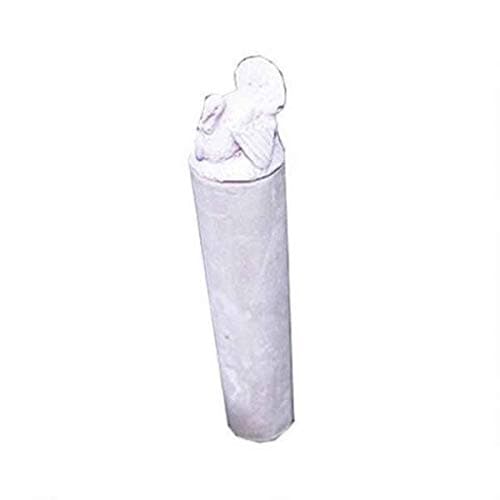
Why a box call needs chalk at all
A box call makes its sound by friction. The paddle drags across the thin lips of the box and the lip vibrates, and the pitch comes from where on the lip you are dragging and how fast. For that to work, the two surfaces have to grip each other. Chalk is what provides the grip.
When a box call goes quiet, slides silently, or starts squeaking like a door hinge, it is almost always one of two things: the chalk is gone, or the call is wet. Nothing is broken. Primos, in its own introduction to box calls, treats chalking as basic upkeep rather than a repair, and the NWTF's guidance on caring for turkey calls makes the same point about friction calls generally: the surfaces are the call.
Not every box call needs it. Sealed and coated all-weather boxes are built so the lid-to-lip contact grips without chalk, and some push-button and no-chalk box calls say so explicitly. If you are not sure which you own, read the maker's page before you put chalk on anything.
Which chalk, and which to avoid
The phrase that matters is nontoxic, oil-free dust chalk, which is Lynch's own wording for what belongs on its calls. Turkey call chalk is sold as such by call makers, and it is cheap.
- Use: chalk sold for turkey calls, often labeled simply as box call chalk. Lynch sells its own and lists it on its store as “Large Chalk.”
- Avoid blackboard chalk. Classroom chalk is usually waxed or oiled so it does not crumble on a board, and that oil is exactly what you do not want between two wooden surfaces. It will make the call slick, not grippy.
- Avoid gymnast's chalk, rosin and anything waxy. Powdered magnesium carbonate behaves differently from call chalk, and sticky compounds change the tone and attract grit.
One honest note on prices and availability: “box call chalk near me” is a common search, and the simplest answer is that it is a mail-order item for most people. Buy two and keep one in the vest.
How to chalk a box call
The whole job takes under a minute, and the two mistakes people make are chalking the wrong surface and using far too much.
- Open the lid and look at the underside of the paddle. That is the surface that gets chalk — the flat face of the lid that rides on the box. Lynch is explicit about it.
- Rub the chalk along the paddle in the direction of the stroke, front to back, covering the whole contact area. Firm pressure, several passes.
- Do not chalk the lips of the box. Chalk on the thin vibrating edges does nothing useful and collects in the corners.
- Wipe off any loose dust and try it. A properly chalked call yelps cleanly on the first stroke. If it squeaks, you have too much; if it slides silent, too little.
- Re-chalk when the sound changes, not on a schedule. In practice that is every few hunts, and always after the call has been damp.
What to buy
Our picks for this
Chalk, and two box calls at either end of the care question
One consumable and two calls: the traditional wooden box that needs this routine, and the sealed all-weather box that mostly does not.
Best chalk for a traditional wood box call
Lynch Box Call Chalk
Call accessory6.1/10Lynch's own box-call chalk, listed on its store as "Large Chalk." Lynch's instructions say to keep the underside of the lid well chalked with nontoxic oil-free dust chalk, which is the specification to shop by.
$15.50Amazon#ad · Price as of November 3, 2026 · Disclosure for the link to Lynch Box Call Chalk
Best classic one-sided box call
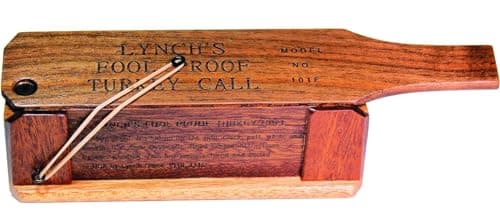
Lynch Fool Proof Box Call (Model #101)
Box call6.5/10The traditional call this routine exists for: straight-grain mahogany body, offset pivoting walnut lid, a single rubber band over two eyelets to hold lid placement. Lynch advises protecting it from excessive moisture and heat.
$46.19Amazon#ad · Price as of November 3, 2026 · Disclosure for the link to Lynch Fool Proof Box Call (Model #101)
Best all-weather box call
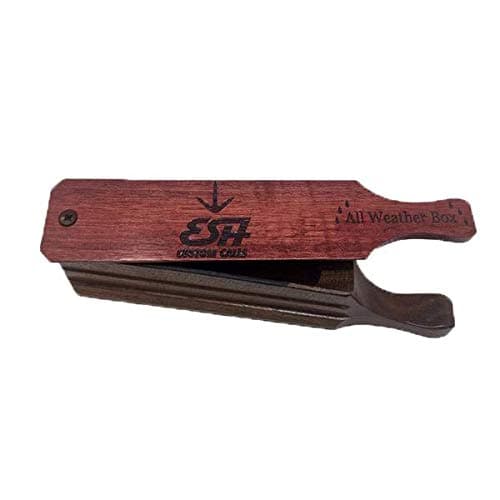
ESH Custom Calls All Weather Turkey Box Call
Box call7.9/10The other answer: walnut and purpleheart sealed in what ESH calls a lifetime sealer, with a coating where the lid and sides meet that ESH says keeps you calling in rain or shine. Less to maintain, by design.
$89.95Amazon#ad · Price as of November 3, 2026 · Disclosure for the link to ESH Custom Calls All Weather Turkey Box Call
Three things that ruin a box call
Storing and drying a wooden call
Three habits cover the whole of box call longevity.
Carry it in a pocket, not loose. A box call rattling against shells and a striker in a vest will get dinged and will also make noise when you walk. The silent box-call pocket in a turkey vest exists for exactly this reason, and the vests with one are ranked in best turkey vests.
Dry it slowly. After a wet hunt, open the lid, leave the call somewhere with moving air at room temperature, and come back the next day. Not a radiator, not a heat vent, not direct sun — fast drying is what cracks wood.
Check the band and the screw. Lynch sells replacement rubber bands and says the Fool Proof requires one, running from the body eyelet to the lid eyelet. A perished band is the single most common box-call failure and the cheapest fix in turkey hunting. On calls with a screw-and-spring hinge, check the tension has not loosened over a season.
When chalk is the wrong answer
If the call got wet, chalk will not save the hunt. Wet wood swells, the lid fit changes, and fresh chalk on a damp paddle just turns to paste. The honest answer in steady rain is a different call: a sealed all-weather box, a no-chalk push-button, an aluminum or glass pot call, or a mouth call, which does not care about water at all.
That is a gear decision worth making before the forecast forces it, and the options are ranked in best waterproof turkey calls. Where birds go on those mornings is in turkey hunting in the rain.
How we picked this
Scored on the specs that decide your season
Every pick is read off the maker's own specs, materials and instructions, then scored on a public rubric built around a first-season hunter: the sounds a call is made to produce and how it holds up in rain, a choke's load ratings and thread chart, the weights, pockets and seat heights you carry all morning. Each figure links straight to the page it came from, so you can check any pick in one click.
Scores come from that documented research with fixed bands, and prices come live from Amazon with the date they were checked. Commissions never set a score or decide a pick. The rubric and its bands are published.
Corrections & updates
- First published. Chalk and care instructions from Lynch's own instruction and product pages, the NWTF and Primos.
Questions
Frequently asked
What kind of chalk do you use on a box call?
Nontoxic, oil-free dust chalk sold for turkey calls — that is Lynch's own wording in its instructions, and Lynch sells its own, listed on its store as “Large Chalk.” Do not use blackboard chalk, which is usually waxed or oiled so it will not crumble on a board; the oil makes a friction call slick instead of grippy.
Where do you put chalk on a box call?
On the underside of the paddle — the flat face of the lid that rides on the box — rubbed front to back along the direction of the stroke until the contact area is covered. Not on the thin lips of the box itself, where it does nothing useful and collects in the corners.
How often should you chalk a box call?
When the sound changes, rather than on a schedule. A call that slides silently needs chalk; a call that squeaks has too much. In practice that is every few hunts, and always after the call has been damp. Chalk it and then run ten yelps, because the chalk is not seated until you have used it.
Can you sand a box call?
Do not, unless the maker publishes instructions for sanding that specific call. The lid and lips are surfaces tuned by hand, and removing wood changes the pitch permanently. A call that will not grip needs chalk or needs drying; sanding is not a fix for either.
What do you do if a box call gets wet?
Open the lid and dry it slowly at room temperature with moving air — never on a radiator, a heat vent or in direct sun, which is what cracks wood. Re-chalk once it is genuinely dry. For the hunt itself, carry a backup that does not care about water: a sealed all-weather box, a no-chalk push-button, an aluminum or glass pot call, or a mouth call.
Keep reading
Related on Strut & Slate
- How to use a box callThe strokes themselves, once the call is chalked.
- Best box callsWhich box calls need this routine and which are sealed against it.
- Best waterproof turkey callsThe backup for the morning chalk cannot save.
- Best turkey calls for beginnersWhere a box call sits among the five call types.
Receipts
Sources
- Lynch Since 1940 — Lynch Call Instructions page (read 2026-09-22)
- Lynch Since 1940 — Featured Products store listing (lists Large Chalk and the Fool Proof) (read 2026-09-22)
- Lynch Since 1940 — Large Chalk store page (title only, no specs) (read 2026-09-22)
- Lynch Since 1940 — Fool Proof Box Call store page, Model #101 (read 2026-09-22)
- Lynch Since 1940 — Rubber Bands for Model #101, #102 store page (read 2026-09-22)
- ESH Custom Calls (Outdoor Hunting Lab store) — ALL WEATHER Turkey Box Call product page, SKU AW-BOX-CALL2 (read 2026-09-22)
- NWTF — Turkey Call Care (read 2026-09-22)
- Primos — An Introduction to Box Calls (read 2026-09-22)
Every spec on this page comes from the maker's own product pages and manuals (or a named dealer's copy where the maker's site blocked us), with sound and performance claims attributed to the maker and any third-party observation attributed to whoever made it. Prices come live from Amazon with the date they were checked. Where a maker leaves a figure unpublished, the page says so and that spec earns the lowest band. Read the full method.