Quick picks
The rankings at a glance
| # | Product | Best for | Score | Price |
|---|---|---|---|---|
| 1 | 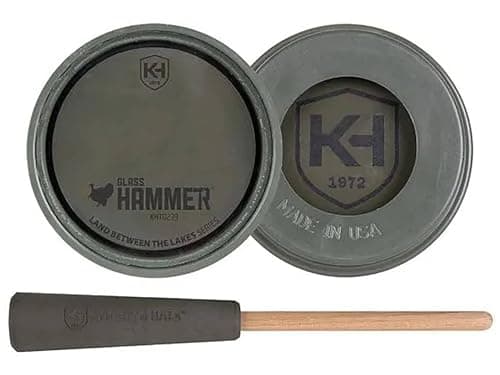 Knight & Hale Glass Hammer Pot Call The glass-surface twin of the Slate Hammer, with the same polymer pot and hickory striker, which Knight & Hale calls "perfect for beginners or someone looking to try a glass call for the first time." | Best glass turkey call overallPot call | 7.1out of 10 | $24.99Amazon |
| 2 | 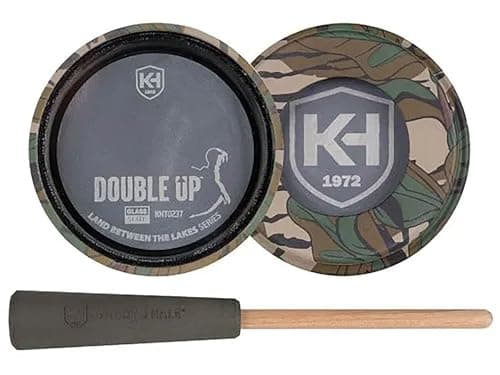 Knight & Hale Double Up Glass/Slate Pot Call A two-sided polymer pot with a glass top for raspy yelps, clucks, cuts and purrs and a slate bottom for "smooth, softer hen sounds," per Knight & Hale, so one call lets you hear glass and slate side by side. | Best for hearing glass against slatePot call | 7.0out of 10 | $38.79Amazon |
| 3 | 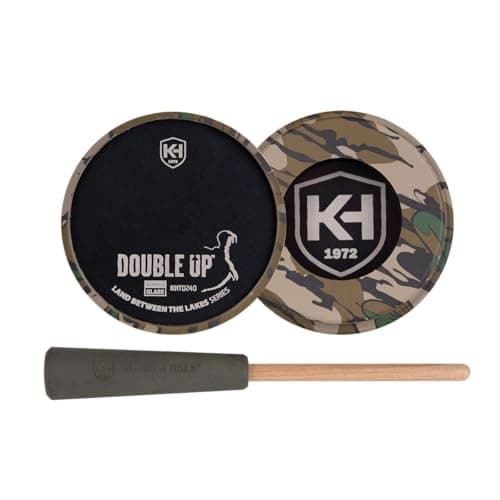 Knight & Hale Double Up Aluminum/Glass Pot Call A two-sided polymer pot with an aluminum top for "sharp, high-pitched volume for far off calling" and a glass bottom for "clear and soft" close-in calling, per Knight & Hale, with a hickory striker and scouring pad. | Best glass call for far and closePot call | 7.0out of 10 | $39.99Amazon |
| 4 | 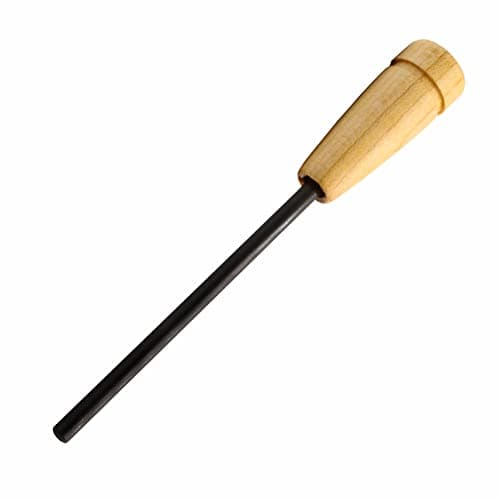 WoodHaven Custom Calls Carbon Striker A hollow 1/4 in carbon dowel under a turned maple head: WoodHaven says it "creates raspy, high pitched yelps and crisp cuts" and changes tone with surface and pressure, which is exactly the second voice a one-striker hunter is missing. | Best striker for a glass surfaceCall accessory | 7.0out of 10 | $19.99Amazon |
#ad · Prices come live from Amazon, last checked November 3, 2026. Scores are ours, computed from published specs and maker claims with the bands on our methodology page, not from field testing. Photos come from each product's Amazon listing. Tap a row for the full write-up.
How we picked
Three calls in our registry have a glass playing surface, and all three are here. Each is scored on the call rubric published with our First-Season Score — beginner learning curve 30%, sound range 20%, weather tolerance 20%, build 15% and carry 15% — because the only thing that matters on a first glass call is whether a new caller can make a hen sound with it before the season starts.
Every surface, striker, included part and warranty term below was read on the maker's own product page and links back to it. We do not test calls, and we will not tell you how glass sounds to a turkey. What we can do is lay out what the makers claim, where they stay silent, and what the NWTF publishes about running and conditioning a friction call.
The fourth pick is a striker rather than a call, and it is scored on the accessory rubric, so its number is not interchangeable with the three call scores. It is here because a glass surface changes voice more with the striker than any other pot surface does.
What glass does that slate doesn't
A pot call is a sounding board with a playing surface glued into it. Change the surface and you change the voice, the volume and how the call behaves when the woods are wet. Glass sits at the high, sharp end: Knight & Hale describes the glass side of its two-sided pot as “raspy” against a slate bottom it calls “smooth, softer hen sounds,” and it credits the glass surface in the Glass Hammer with “great sound clarity” that works “at any range.”
That is the practical case for glass on a first-season vest. A slate call is the softer, more forgiving voice for a bird inside 60 yards. Glass carries. On a windy ridge or across a field, a raspy, high-pitched yelp off glass gets heard when soft slate talk does not, and the same surface still purrs when the bird closes. The full three-surface comparison, including aluminum, is in slate vs glass vs aluminum pot calls.
Two honest caveats before you buy. First, none of these three calls carries a published wet-weather claim, so glass is not the rain answer — aluminum is the surface whose makers make that claim, and those picks are in best waterproof turkey calls. Second, “crystal” on a call package usually means a glass-family surface conditioned the same way; nobody in our registry sells a crystal pot, so this page does not rank one.
The three calls, side by side
Everything in this table is the maker's own published claim, linked to the page it came from. Where a maker publishes nothing — weight, in all three cases — the table says so rather than guessing.
Why the Glass Hammer wins
The margin is 0.1 of a point, and it is worth understanding exactly where it comes from, because it tells you which call to buy and why.
The Glass Hammer scores 7.1. Both Double Ups score 7.0. The two two-sided calls actually beat it on sound range — two surfaces with published, different tones is more voice than one surface has — and they tie it on weather, build and carry, because all three are injection-molded polymer pots with a hickory striker, a scouring pad and the same 1-year Knight & Hale warranty.
The Glass Hammer takes the lead on the one metric that carries the most weight: the beginner learning curve. It is the only call of the three whose maker says, in its own words, that it is “perfect for beginners or someone looking to try a glass call for the first time,” and Knight & Hale also calls it “economically priced.” Neither Double Up page makes any ease-of-use claim at all. On a site written for a first season, a maker telling you a call is for first-timers is evidence, and a maker saying nothing is the absence of it.
One surface or two
The two Double Ups are the same idea executed for two different situations, and the choice between them is genuinely about the ground you hunt.
Glass over slate is the learning combination. Knight & Hale publishes the tone split plainly: the glass top is raspy, the slate bottom is “smooth, softer hen sounds.” Flip the pot over with the same striker and you hear exactly what a surface change does — which is the fastest way to understand why hunters own more than one pot call. Its one weakness is the one the maker's own silence creates: the slate side has no weather claim, so half the call is out of service on a soaked morning.
Aluminum over glass is the hunting combination. Knight & Hale calls the aluminum top “sharp, high-pitched volume for far off calling” and the glass bottom “clear and soft” for close work. That is a locate-then-work tool in one pot: aluminum to reach across a hollow, glass to talk to a bird at 40 yards. Both sides list five sounds — cackle, cluck, cut, purr and yelp.
One striker for two surfaces is the compromise in both calls, which is the argument for the fourth pick on this page.
Glass is half striker
On a glass surface the striker does more work than it does on slate. WoodHaven says its Carbon Striker “creates raspy, high pitched yelps and crisp cuts with realism” and, more usefully, that it “creates different tones and pitches based on different pot call surfaces and pressure.” That is a hollow 1/4 in carbon dowel under a maple head, and it is a different sound from the solid hickory striker in the box.
Two practical notes. A carbon shaft does not soak up water the way bare wood does, although WoodHaven makes no weather claim and the head is still wood. And a high, raspy voice is the wrong tool for soft tree talk at first light, so a carbon striker is an addition to the hickory one, never a replacement. Six strikers, ranked, are in best slate call strikers.
The stone, not the scouring pad
This is the one thing that sends new glass-call owners back to the store convinced they bought a dud. Glass does not condition with the scrub pad that comes with a slate call.
The frosted look is the whole test. A glass surface that still shines is a glass surface that will squeak or slide silently no matter how good your hand is. Step-by-step instructions, by surface, are in how to condition a slate call.
In detail
The picks, in full
Rank 1
Best glass turkey call overall
Knight & Hale Glass Hammer Pot Call
The glass-surface twin of the Slate Hammer, with the same polymer pot and hickory striker, which Knight & Hale calls "perfect for beginners or someone looking to try a glass call for the first time."
Spec sheetEvery row sourced to the maker
| Category | Pot call |
|---|---|
| Type | Pot call |
| Sounds (per maker) | Yelps, clucks, cuts, purrs; the technique section also covers the cackle (per Knight & Hale) |
| Surface | Glass |
| Striker | Hickory (included) |
| Material | Durable, injection-molded polymer pot |
| Weather | No explicit weather claim (glass surface) |
| Weight | Not published |
| Included | Hickory striker, scouring pad |
| Warranty | Standard 1-year from date of purchase; excludes weather-related conditions (Knight & Hale warranty page) |
How the 7.1 score breaks down
- Beginner learning curve (30%)
- 7
- Sound range (20%)
- 8
- Weather tolerance (20%)
- 7
- Build & materials (15%)
- 7
- Carry & vest noise (15%)
- 6
What the specs support
- Knight & Hale calls it "perfect for beginners or someone looking to try a glass call for the first time."
- Knight & Hale describes it as "economically priced."
- A glass surface Knight & Hale says offers "great sound clarity" that works "at any range."
- Striker and scouring pad included, plus a 1-year warranty.
Where it falls short
- No explicit wet-weather claim on the product page.
- Polymer pot rather than wood.
- Only one striker in the box.
Skip this if…
…you already own a glass pot call; this is the entry-level version of the same surface.
#ad · Price as of November 3, 2026 · Disclosure for the link to Knight & Hale Glass Hammer Pot Call
Rank 2
Best for hearing glass against slate
Knight & Hale Double Up Glass/Slate Pot Call
A two-sided polymer pot with a glass top for raspy yelps, clucks, cuts and purrs and a slate bottom for "smooth, softer hen sounds," per Knight & Hale, so one call lets you hear glass and slate side by side.
Spec sheetEvery row sourced to the maker
How the 7.0 score breaks down
- Beginner learning curve (30%)
- 6
- Sound range (20%)
- 9
- Weather tolerance (20%)
- 7
- Build & materials (15%)
- 7
- Carry & vest noise (15%)
- 6
What the specs support
- Glass and slate in one pot, with the tone difference published by the maker.
- Five sounds listed (per Knight & Hale).
- Striker and scouring pad included.
- 1-year Knight & Hale warranty.
Where it falls short
- No beginner or ease-of-use claim from the maker.
- The slate side has no weather claim.
- One striker for both surfaces.
Skip this if…
…you mainly hunt in the rain; the slate side carries no weather claim, so only half this call is a wet-day surface.
#ad · Price as of November 3, 2026 · Disclosure for the link to Knight & Hale Double Up Glass/Slate Pot Call
Rank 3
Best glass call for far and close
Knight & Hale Double Up Aluminum/Glass Pot Call
A two-sided polymer pot with an aluminum top for "sharp, high-pitched volume for far off calling" and a glass bottom for "clear and soft" close-in calling, per Knight & Hale, with a hickory striker and scouring pad.
Spec sheetEvery row sourced to the maker
How the 7.0 score breaks down
- Beginner learning curve (30%)
- 6
- Sound range (20%)
- 9
- Weather tolerance (20%)
- 7
- Build & materials (15%)
- 7
- Carry & vest noise (15%)
- 6
What the specs support
- Two surfaces with different published tones: aluminum for distance, glass for close birds.
- Five sounds covered by the maker's technique section.
- Mossy Oak Greenleaf finish on a durable polymer pot.
- 1-year Knight & Hale warranty.
Where it falls short
- No beginner or ease-of-use claim from the maker.
- No explicit weather claim.
- One striker for two very different surfaces.
Skip this if…
…you want one simple surface to learn on first; start with the single-surface Slate Hammer or Glass Hammer.
#ad · Price as of November 3, 2026 · Disclosure for the link to Knight & Hale Double Up Aluminum/Glass Pot Call
Rank 4
Best striker for a glass surface
WoodHaven Custom Calls Carbon Striker
A hollow 1/4 in carbon dowel under a turned maple head: WoodHaven says it "creates raspy, high pitched yelps and crisp cuts" and changes tone with surface and pressure, which is exactly the second voice a one-striker hunter is missing.
Spec sheetEvery row sourced to the maker
How the 7.0 score breaks down
- Documented function (30%)
- 7
- Ease of use (25%)
- 9
- Build (20%)
- 8
- Carry & weight (15%)
- 5
- Warranty (10%)
- 3
What the specs support
- A carbon shaft and a maple head is a different sound from solid wood, so it genuinely adds a voice rather than a spare.
- WoodHaven names the sounds it is built for: raspy, high-pitched yelps and crisp cuts.
- The maker states the tone changes with surface and pressure, so one striker covers a slate and a glass differently.
- WoodHaven lists it in the same mid price band as its Deluxe striker and Ninja Stick, not at flagship money.
Where it falls short
- No published weather claim despite the carbon shaft; the head is still wood.
- No overall length or weight published, so balance is unknowable until it is in your hand.
- No warranty published, only a returns policy.
- A high, raspy voice is not what you want for soft tree talk at first light.
Skip this if…
…you only own one pot call and have not learned a clean yelp on it yet; a striker that rewards pressure changes is a second-season tool.
#ad · Price as of November 3, 2026 · Disclosure for the link to WoodHaven Custom Calls Carbon Striker
Buyer's guide: buying a glass call once
Buy the abrasive at the same time
All three of these calls ship with a scouring pad, which is the tool for slate and aluminum. For the glass side you want sandpaper, drywall screen or a sanding stone, per the NWTF. Order it with the call, not after your first frustrating practice session.
One surface first, two surfaces second
A two-sided pot is better value and a worse teacher. If you have never run a pot call, the single-surface Glass Hammer plus the pot-call steps will have you yelping in an evening. Buy the Double Up when you already know what a clean yelp feels like and want a second voice.
Nobody publishes a weight, so judge carry by the pot
Not one of these three calls has a published weight. They are all polymer pots that live in a vest call pocket, and the thing that actually matters is whether yours has a pocket that holds a pot flat and a striker separately — see best turkey vests. A drink koozie over the pot stops it rattling, which is Hickoff's own trick.
Polymer is not a downgrade
All three pots here are injection-molded polymer rather than turned wood. For a first season that is the right trade: a polymer pot shrugs off being sat on, dropped and rained on, and the surface — not the pot material — is what makes the sound. Wood pots are a nicer object and a later purchase.
The warranty has a hole in it
Knight & Hale's standard warranty runs 1 year from purchase and explicitly excludes weather-related conditions. That is a reasonable term on a friction call, and it is another reason not to treat glass as a rain surface.
What to buy with it
A box call, if you do not already own one. The honest order for a first season is one call you can run on day one and one you can grow into: a box or push-button for the first morning, a pot call for everything after. That order is laid out in best turkey calls for beginners.
How we picked this
Scored on the specs that decide your season
Every pick is read off the maker's own specs, materials and instructions, then scored on a public rubric built around a first-season hunter: the sounds a call is made to produce and how it holds up in rain, a choke's load ratings and thread chart, the weights, pockets and seat heights you carry all morning. Each figure links straight to the page it came from, so you can check any pick in one click.
Scores come from that documented research with fixed bands, and prices come live from Amazon with the date they were checked. Commissions never set a score or decide a pick. The rubric and its bands are published.
Corrections & updates
- First published. Surfaces, included parts and warranty terms from Knight & Hale's and WoodHaven's own product pages; conditioning guidance from the NWTF.
Questions
Frequently asked
What is the best glass turkey call?
Knight & Hale's Glass Hammer, on published evidence: it scores 7.1 on our call rubric and it is the only glass pot in our registry whose maker calls it “perfect for beginners or someone looking to try a glass call for the first time.” It ships with a hickory striker and a conditioning pad and carries a 1-year warranty.
Is a glass or slate turkey call better?
They do different jobs. Knight & Hale publishes the difference on its own two-sided pot: the glass side is “raspy” and carries, the slate side makes “smooth, softer hen sounds.” Glass for wind, distance and sharp cutting; slate for soft talk to a close bird. If you can only own one, slate is the more forgiving first surface and glass is the louder one.
How do you condition a glass turkey call?
With an abrasive, not a scouring pad. The NWTF lists “sandpaper, drywall screen or a sanding stone” for glass and crystal surfaces, where slate and aluminum get scrub pads. Work in one direction until the surface looks evenly frosted rather than shiny, then run the striker across those scratches. Keep your fingers off the playing surface.
What striker is best for a glass call?
A harder, higher-pitched one than the hickory striker in the box. WoodHaven says its Carbon Striker produces “raspy, high pitched yelps and crisp cuts” and changes tone with the surface and the pressure you use, which is exactly what a glass surface rewards. Keep the hickory striker for soft tree talk.
Do glass turkey calls work in the rain?
Not reliably, and no maker in our registry claims they do. None of these three glass calls carries a published wet-weather claim, and Knight & Hale's warranty excludes weather-related conditions. Aluminum is the surface whose makers publish all-weather claims; our wet-morning picks are in best waterproof turkey calls.
Is a crystal turkey call the same as glass?
For conditioning purposes, treat it the same. The NWTF groups glass and crystal together as the surfaces that need sandpaper, drywall screen or a sanding stone, and Phelps's instructions for its conditioning stone cover crystal and aluminum in one sentence. No crystal pot is in our registry, so this page does not rank one.
Keep reading
Related on Strut & Slate
- Best slate callsAll seven pot calls, slate, glass and aluminum, in one ranking.
- Slate vs glass vs aluminumWhat each surface sounds like and how it handles weather.
- How to condition a slate callThe stone-versus-scrub-pad routine, surface by surface.
- Best slate call strikersSix strikers ranked, including the carbon one glass likes.
Receipts
Sources
- Knight & Hale — Glass Hammer Pot Call (LBL Series) product page, SKU KHT0239 (read 2026-09-22)
- Knight & Hale — Double Up Glass/Slate Pot Call (LBTL Series) product page, SKU KHT0237 (read 2026-09-22)
- Knight & Hale — Double Up Aluminum/Glass Pot Call (LBL Series) product page, SKU KHT0240 (read 2026-09-22)
- Knight & Hale — Warranty Information page (read 2026-09-22)
- WoodHaven Custom Calls — Carbon Striker product page (hollow 1/4 in carbon dowel, maple head) (read 2026-10-05)
- WoodHaven Custom Calls — Strikers category listing (11 striker models and their list prices) (read 2026-10-05)
- WoodHaven Custom Calls — Returns & Shipping page (read 2026-09-22)
- NWTF — Help! (Part 1) My Friction Calling Stinks! (read 2026-09-22)
- NWTF — Turkey Call Care (read 2026-09-22)
Every spec on this page comes from the maker's own product pages and manuals (or a named dealer's copy where the maker's site blocked us), with sound and performance claims attributed to the maker and any third-party observation attributed to whoever made it. Prices come live from Amazon with the date they were checked. Where a maker leaves a figure unpublished, the page says so and that spec earns the lowest band. Read the full method.