The answer, by maker
This question has no single answer, because it is set by the tube in your barrel rather than by physics alone. Here is what the four makers in our registry publish, in their own words.
- Carlson's: “Lead, Copper, Nickel, Bismuth, and Hevi-Shot can be used in any Carlson's Extended Turkey choke,” and “never shoot steel shot larger than #4 through any turkey choke.” So: small steel is permitted, big steel is not. Carlson's choke tube information page carries the rule.
- Patternmaster: its Code Black Turkey is “designed specifically for turkey loads” and “NOT safe for use with steel shot.” That is a flat no, in the maker's own capital letters.
- Primos: the Tight Wad “shoots lead, cooper-plated lead, and HEVI-SHOT” and is “not designed to shoot steel shot.” Its TSS turkey tube says “not to be used with Steel Shot.”
- Kick's: the Gobblin' Thunder “can be safely used with lead, TSS, or other non-toxic loads.” Note what that sentence does and does not say: non-toxic covers several materials, and the only way to know whether yours is included is to ask Kick's about your specific load rather than to assume.
Two makers permit small steel, two rule it out. That spread is the whole reason this page exists: there is no industry-wide standard you can apply to an unlabeled tube.
Why steel and a tight tube do not mix
Three things stack up here, and together they explain every warning above.
Steel is harder than lead and does not deform. A lead or tungsten pellet squeezes slightly as the shot column is forced through a constriction. A steel pellet does not; it transfers that force into the choke wall instead. The tighter the constriction, the more force there is to transfer.
A turkey choke is the tightest tube you own. Carlson's publishes Full as about 0.030 in of constriction and Turkey as 0.045 in or more — and its turkey tubes run to 0.640 in in a 12 gauge, against 0.700 in for a plain Full. You are asking undeformable pellets to funnel through a much smaller hole.
Velocity makes it worse. Carlson's own rule on its flush-mount tubes names speed as well as pellet size: “No Steel shot larger than #BB or speeds exceeding 1550 fps should be used in choke tubes tighter than full.” Modern steel waterfowl loads are fast.
Reading your own tube's limit
Do this before you shoot anything unusual through a turkey tube.
- Take the tube out and read it. Most makers stamp the constriction and often a shot restriction on the tube itself. Carlson's prints “Do Not Use Any Steel Shot Larger Than #4, Slugs, Sabots, Rifled Slugs, or 00/000 Buckshot” on turkey-choke pages, and a tube may carry a short version of that.
- Look the exact model up on the maker's site, not on a retailer listing. Retailers routinely copy the wrong restriction across a whole product family. We have seen Carlson's generic turkey-choke steel restriction printed on its own waterfowl tube page, which is a good illustration of how muddled this gets.
- If the maker is silent, treat it as a no. No published rating is not permission. Several tubes in our registry publish nothing at all about loads — JEBS publishes no load rating on its Head Hunter product page, for instance — and the safe reading of silence is lead or tungsten only.
- Ask the maker if you cannot tell. Both Carlson's and Indian Creek publish customer-service contacts and fitment guides. One email is cheaper than a barrel.
The other restrictions on the same label
Steel is not the only thing that should never go through a turkey tube, and the same label usually spells out the rest: slugs, sabots, rifled slugs and 00/000 buckshot are all on Carlson's exclusion list for turkey chokes.
That matters more than it sounds, because the gun you are shooting turkeys with is often the gun you shoot deer or clays with. Swapping the tube when you swap seasons is the whole habit. A turkey tube lives in a vest pocket or a gun case, not in the barrel year-round.
What to shoot instead
If your reason for asking is “I have steel shells and a turkey choke in the gun,” the fix costs less than a box of shells: fit an open tube for the steel and keep the turkey tube for turkeys.
- For ducks and geese: a waterfowl tube, which is built around steel. Carlson's Cremator waterfowl tubes run 0.725 to 0.705 in against 0.680 in or tighter for its turkey tubes in the same thread — the comparison is in turkey choke vs duck choke.
- For small game and clays: a plain replacement Modified or Full tube. Carlson's flush-mount line names steel, lead and HEVI-Shot as usable across its constrictions, within the #BB and 1550 fps limits.
- For turkeys: lead, copper-plated lead, HEVI-Shot-type tungsten blends or TSS, matched to what your tube is rated for. Which shot size, by gauge, is in what size shot for turkey.
Three tubes and what each one allows
These three are scored on the choke rubric published with our First-Season Score, and they are here as an illustration of three different published answers rather than as a ranking against each other. Every figure on their cards links to the maker page it came from.
Our picks for this
A limit, a flat no, and the tube that solves it
One turkey tube that permits small steel, one that forbids steel entirely, and the waterfowl tube to fit when you are shooting steel on purpose.
Best Mossberg 500 choke for lead loads
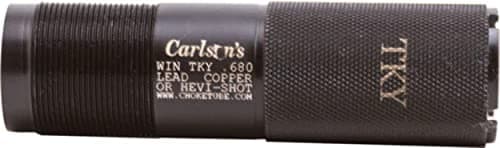
Carlson's Extended Turkey Choke Tube, Winchester/Browning Invector/Mossberg 500, 12 Gauge
Turkey choke8.5/10Carlson's publishes the clearest rule in the category: lead, copper, nickel, bismuth and HEVI-Shot in any Extended Turkey tube, and never steel larger than #4. Six exit diameters for the Mossberg 500 thread, with a chart that picks the size by shot size.
$54.49Amazon#ad · Price as of November 2, 2026 · Disclosure for the link to Carlson's Extended Turkey Choke Tube, Winchester/Browning Invector/Mossberg 500, 12 Gauge
Best for thread coverage and warranty
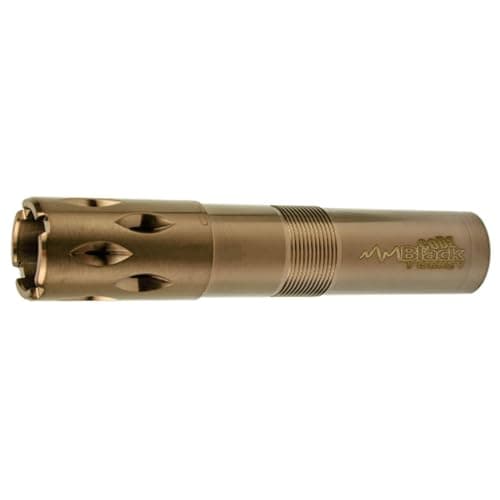
Patternmaster Code Black Turkey Choke Tube, 12 Gauge
Turkey choke6.0/10The flat no: Patternmaster says the Code Black Turkey is designed specifically for turkey loads and is "NOT safe for use with steel shot." It publishes no lead or TSS rating either, which is its own limitation.
$89.99Amazon#ad · Price as of November 2, 2026 · Disclosure for the link to Patternmaster Code Black Turkey Choke Tube, 12 Gauge
Best duck choke for the same shotgun
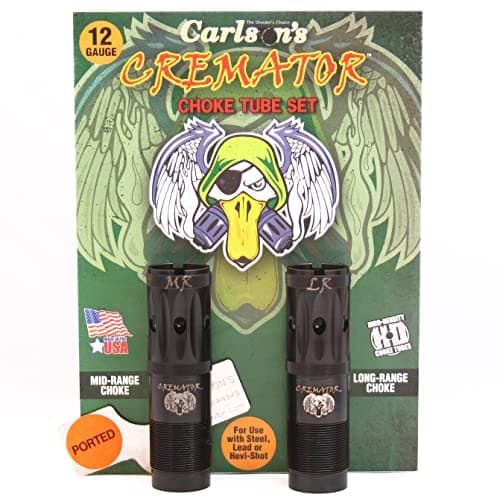
Carlson's Cremator Ported Waterfowl Choke Tube, Win/Browning Inv/Moss 500, 12 Gauge
Turkey choke7.6/10The answer when steel is the point: a waterfowl tube built around steel loads, in three named ranges from 0.725 to 0.705 in - 0.025 to 0.065 in more open than the turkey tubes for the same gun.
$125.49Amazon#ad · Price as of November 2, 2026 · Disclosure for the link to Carlson's Cremator Ported Waterfowl Choke Tube, Win/Browning Inv/Moss 500, 12 Gauge
Turkey loads are not steel anyway
Worth saying plainly, because it resolves the question for most people asking it: spring turkey loads are not sold in steel. The shot materials in the turkey aisle are lead, copper-plated lead, tungsten blends and TSS, and the reason is that steel is too light to carry the energy a turkey's head and neck requires at 40 yards. Density is the whole argument, and it is laid out in TSS vs lead turkey loads.
Two caveats where steel does enter turkey hunting. Some states restrict shot materials for spring turkey, and a few require non-toxic shot on certain properties, so your regulations digest may make this decision for you. And fall turkey hunting sometimes happens on ground with non-toxic requirements. In both cases the rule is the same: match the load to what your choke maker publishes, and pattern the combination before you hunt with it — Mississippi State Extension's patterning publication is the procedure.
What damage looks like
If you have already shot steel through a tight tube, stop and look at it before the next shot. Unscrew the choke and check for a visible bulge or ring at the constriction, scoring down the inside of the tube, cracks at the muzzle end, and whether the tube still threads smoothly. Look into the barrel at the threads as well.
Anything that is not smooth and round means the tube goes in the bin and a gunsmith looks at the barrel. Then re-pattern with the replacement tube, because your old target no longer describes your gun — the procedure is in how to pattern a turkey gun.
How we picked this
Scored on the specs that decide your season
Every pick is read off the maker's own specs, materials and instructions, then scored on a public rubric built around a first-season hunter: the sounds a call is made to produce and how it holds up in rain, a choke's load ratings and thread chart, the weights, pockets and seat heights you carry all morning. Each figure links straight to the page it came from, so you can check any pick in one click.
Scores come from that documented research with fixed bands, and prices come live from Amazon with the date they were checked. Commissions never set a score or decide a pick. The rubric and its bands are published.
Corrections & updates
- First published. Steel-shot restrictions quoted from Carlson's, Patternmaster, Primos and Kick's own product and information pages.
Questions
Frequently asked
Can you shoot steel shot through a turkey choke?
Only within the limit your maker prints, and some makers say no. Carlson's allows steel no larger than #4 through any of its turkey chokes; Patternmaster says its Code Black Turkey is not safe for steel at all, and Primos says the Tight Wad is not designed for steel. If your tube publishes nothing, treat that as a no.
What size steel shot can go through a turkey choke?
Where it is allowed at all, #4 steel is the common published ceiling — that is Carlson's rule for its turkey tubes. Carlson's also caps steel at #BB and 1550 fps for any tube tighter than Full, which tells you how much the constriction matters.
What happens if you shoot steel through a tight choke?
Steel pellets do not deform the way lead does, so the force goes into the choke wall. The outcomes makers are warning about are a bulged or split tube and damage at the barrel threads, with deformed pellets and unpredictable patterns along the way. Inspect the tube before shooting again.
Can you shoot slugs or buckshot through a turkey choke?
No. Carlson's turkey-choke restriction names slugs, sabots, rifled slugs and 00/000 buckshot alongside large steel. Swap to an open or dedicated tube for those loads.
Do turkey loads use steel shot?
Not in the normal turkey aisle. Turkey loads are lead, copper-plated lead, tungsten blends or TSS, because steel is too light to carry the energy needed at turkey ranges. Check your state regulations, though: a few properties and seasons require non-toxic shot.
How do I know what my choke is rated for?
Read the tube itself, then confirm the exact model on the maker's own website rather than a retailer listing — retailers copy restrictions across product families. If the maker publishes no load rating, assume lead or tungsten only, or email them.
Keep reading
Related on Strut & Slate
- Turkey choke vs duck chokeSame barrel, opposite jobs - and the steel rules that go with each.
- What choke for turkey huntingConstriction by gauge and load, with the published charts.
- What size shot for turkeyWhich shot size for your gauge, lead or tungsten.
- Best turkey chokesThe full ranking, with every maker's published load rating.
Receipts
Sources
- Carlson's Choke Tubes — Choke Tube Information page: 17-4 PH stainless, patterning information, turkey choke chart by load size (read 2026-09-22)
- Carlson's Choke Tubes — Winchester/Browning Inv/Moss 500 Flush Mount Replacement Stainless Choke Tubes, 12 ga: Full .700 (52215), Improved Modified .705 (52214), Modified .710 (52213), Turkey .680 (59891) (read 2026-09-28)
- Carlson's Choke Tubes — Winchester/Browning Inv/Moss 500 Cremator Ported Waterfowl Choke Tubes, 12 ga: Close Range .725 (11543), Mid Range .715 (11545), Long Range .705 (11547) (read 2026-09-28)
- Patternmaster — 12ga Mossberg 500/535/930 Code Black Turkey 0.665 Choke Tube (5397) product page (read 2026-09-22)
- Primos — TSS Turkey Choke Tubes product page (JellyHead TSS), SKUs 69415 / 69422, incl. constriction/fit features list (read 2026-09-22)
- Kick's Industries — Gobblin' Thunder Turkey Choke Tubes page (17-4 PH, ported, lead/TSS statement, choke selector) (read 2026-09-22)
- JEBS Choke Tubes — JEBS Turkey Choke 12 Gauge Head Hunter product page (read 2026-09-22)
- Mississippi State University Extension — How to Pattern a Shotgun for Turkey Hunting (P3234) (read 2026-09-22)
Every spec on this page comes from the maker's own product pages and manuals (or a named dealer's copy where the maker's site blocked us), with sound and performance claims attributed to the maker and any third-party observation attributed to whoever made it. Prices come live from Amazon with the date they were checked. Where a maker leaves a figure unpublished, the page says so and that spec earns the lowest band. Read the full method.