
Start with the gun in the closet
Every spring, somebody walks into a gun shop to buy a turkey gun and walks out having solved a problem they did not have. A turkey gun is a shotgun with a tight choke, a pattern you have checked on paper, and a stock that fits the person holding it. Nearly any pump or semi-auto in 12 or 20 gauge can be all three. That is the whole argument behind our guns, chokes and loads guides, and it is why this page carries a choke, a sling and a sight instead of a gun rack. If you have read that and still want to buy a gun, the current models are compared, model by model, in best turkey shotguns for beginners, with the autoloaders in best semi-automatic turkey shotguns and the short-stock guns in best youth turkey shotguns.
Missouri's Department of Conservation puts the baseline about as plainly as a state agency can in its turkey hunting equipment guidance: “12-gauge shotguns are the standard among turkey hunters. Smaller gauges, particularly 20 gauges, are a great choice for young hunters.” On chokes it says “the most popular is an extra-full choke, which gives the tightest pattern. A tight pattern is important in order to strike the vital head-and-neck area.” Notice what is not in there: a brand, a model, a camo pattern or a price.
Fit is what actually matters
Turkey hunting is the one kind of shotgunning where you aim rather than swing. You are sitting against a tree, often twisted toward the bird, holding the gun up on your knee for minutes at a time. A gun that is too long in the stock pulls your head off the comb when you are seated and turned. A gun that is too heavy shakes by the time the bird is in range. Neither problem is fixed by a nicer receiver.
Three things to check with an unloaded gun, in the living room, before you spend anything:
- Length. Sit on the floor with your back against a wall, mount the gun the way you would on a bird quartering to your left (or right, if you shoot left-handed). If your nose ends up crowding your thumb or your arm is fully stretched to reach the fore-end, the stock is wrong for you seated. A shorter youth or compact stock is a far cheaper fix than a new gun.
- Weight, held up. Hold the gun in the shooting position for a full minute. Turkeys take their time. If your muzzle is drawing circles at forty seconds, you want the lighter gun, not the one with the longer barrel.
- Where your eye lands. Mount the gun with your eyes closed, then open them. If the bead is not sitting on top of the rib where you expected, that is the gun and your face disagreeing, and it will show up on the pattern board.
Recoil belongs in the fit conversation too. Turkey loads are heavy for the gauge, and a light gun with a stout load produces a flinch that no optic will fix. If a young or recoil-shy hunter is the one shooting, that is the strongest argument for a 20 gauge there is.
12, 20 or .410
Gauge is the only gun decision that changes what you can do, and even it changes less than it used to. Missouri's guidance is the practical summary: 12 gauge is the standard, 20 gauge is a good choice for young hunters, and “shooting at a turkey at more than 40 yards is not recommended, regardless of which gauge shotgun is used.” That last clause is the one to tape to the gun cabinet. The full head-to-head is in 20 gauge vs 12 gauge for turkey.
- 12 gauge. The most load choice, the most choke choice, the most recoil. If you already own one, you own a turkey gun.
- 20 gauge. Lighter to carry and to shoot. Fewer choke options than 12 gauge, but every maker in our choke registry builds turkey tubes for it. The right answer for a lot of adults too, not just kids.
- .410. Real now in a way it was not a decade ago, and still the least forgiving. The NWTF's piece on whether .410 shotguns are ready for turkey hunting reports that a 13/16-ounce load of No. 9 TSS holds about 295 pellets and that test guns “averaged 125 to 150 pellets in a 10-inch circle at 40 yards.” It also flags the catch for a first-time buyer: “most current .410 bore shotguns come with fixed full-choked barrels,” meaning you may not be able to fit a turkey choke at all. We go deeper in .410 for turkey hunting.
Five checks before you buy anything
Run these five in order. The first two cost nothing and settle most of the question; the last three are where the small purchases live.
- Does the barrel take screw-in chokes? Look down the muzzle for the notches of a removable tube, or check the barrel markings. A fixed full-choke barrel can still kill turkeys, but you lose the single biggest upgrade available to you.
- Which thread system is it? This is where beginners lose money, because gun names and thread names do not line up. Carlson's choke tube interchange guide files the Mossberg 500, 535, 590, 930, 940 and Maverick 88 under its Winchester / Browning Invector / Mossberg 500 threads, while the Mossberg 835, 935 and 535 Turkey Thug take a different, larger pattern. Kick's says it outright on its Gobblin' Thunder page: “Mossberg has multiple thread systems that are not interchangeable.” Same trap on the Remington side, where Carlson's guide puts most 870s on Rem Choke threads but the 870 Bone Collector on Remington Pro Bore. Find your exact model on the maker's chart before you order a tube. Which constriction to then pick is covered in what choke for turkey hunting.
- Can it carry a sight, if you ever want one? Most turkey guns wear a bead on a vent rib and nothing else. A red dot needs a drilled-and-tapped receiver, a Picatinny rail, or a clamp-on rib mount. Vortex publishes a compatible shotguns list for its shotgun sight covering Benelli, Beretta, Browning, Franchi, Ithaca, Mossberg, Remington, Retay, Savage and Stevens, Stoeger, TriStar and Weatherby models, with different screw threads by gun. That list is a useful reality check even if you never buy that sight. Our ranked options are in the best red dots for turkey hunting.
- Does it have sling studs? You will carry this gun a long way before you shoot it. Slings attach differently by gun, so check for studs before you buy one.
- Will it feed the shell length you want? Most turkey loads are 3 in, some 3.5 in. A 2.75 in chamber is not a problem in itself, but it limits which loads you can pattern. What to feed it is in what size shot for turkey.
Our picks for this
The three things worth buying before a new gun
A turkey choke that fits your threads, a sight only if your gun can take one, and a sling so the gun is still in your hands at 10 a.m. Guns and shotshells are not sold here, so nothing below is a firearm or ammunition.
- Illustrative photo
Best budget turkey choke
Primos Tight Wad Turkey Choke Tube, 12 Gauge
Turkey choke6.2/10The budget turkey tube: one exit diameter per thread across five 12 ga thread systems, tool-free to install, rated by Primos for lead, copper-plated lead and HEVI-Shot but not for TSS or steel.
Check price on Amazon#ad · Price set by Amazon · Disclosure for the link to Primos Tight Wad Turkey Choke Tube, 12 Gauge
- Illustrative photo
Best budget red dot
Bushnell Trophy TRS-25 Dot Sight
Red dot8.4/10The low-cost way to find out whether a dot suits you. It needs a Picatinny rail on the gun, and it has no auto shutoff, so switch it off after the hunt.
Check price on Amazon#ad · Price set by Amazon · Disclosure for the link to Bushnell Trophy TRS-25 Dot Sight
- Illustrative photo
Best simple shotgun sling
Allen Company Endura Shotgun Sling, Mossy Oak Break-Up Country
Shooting accessory7.8/10A 2.4 oz padded camo sling that adjusts from 31 in to 42 in. Check how it attaches to your gun first: Allen's own copy both says it needs no swivels and mentions swivels.
Check price on Amazon#ad · Price set by Amazon · Disclosure for the link to Allen Company Endura Shotgun Sling, Mossy Oak Break-Up Country
Pattern it before you trust it
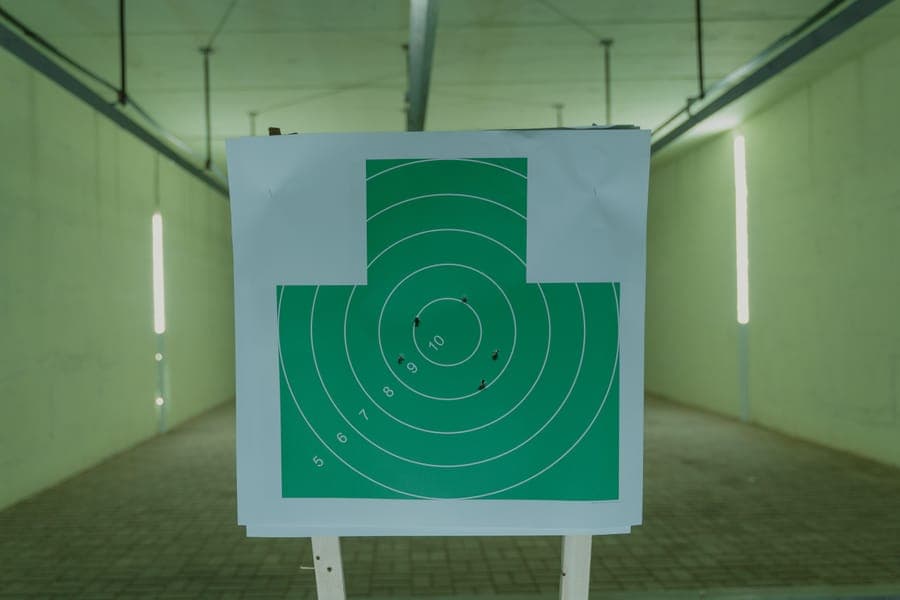
A turkey gun is not finished until you have shot it at paper. Mississippi State University Extension's publication on patterning a shotgun for turkey hunting gives the routine that everything else on this site refers back to: 40 yards is “a standard distance among turkey hunters,” shoot from a stable rest, then “lay the target down and draw a 10-inch circle around the heaviest part of the pattern” and count the holes. The publication puts the accepted number at 100 holes inside that circle.
Missouri's guidance adds the reason to shoot more than one load: “pattern your gun with several sizes and select the load and shot size that pattern best,” and notes that “the most common shot sizes are No. 4, 5, and 6.” Two guns of the same model can prefer different loads, which is exactly why no chart, ours included, can tell you your range. The full walkthrough, targets and all, is how to pattern a turkey gun, and the choke that makes the biggest difference to that session is in our turkey choke picks.
What your state says about the gun
What to skip in year one
- A dedicated turkey gun. Short barrels, full camo dips and factory turkey chokes are nice. None of them out-shoots the gun you already own with a good tube and a load you patterned.
- A choke bought before you know your threads. The single most common wasted purchase in this category. Check the maker's chart, not the gun's name.
- An optic on a gun that cannot take one. If there is no rail and no drilled receiver, a dot means a rib clamp or a gunsmith. Decide that before the sight is in the cart, and read red dot vs bead for turkey hunting first.
- The most expensive shells on the shelf, in bulk. Buy one box each of two or three loads, pattern them, and then buy the winner. Scores follow the rubric on our methodology page; your gun follows nobody's.
How we picked this
Gear we claim to have field-tested: none
Plenty of turkey sites say they ran every call on the list all spring. We don't say that, and we say so on every page. What we do instead: read each maker's published specs, materials and instructions; note the sounds a maker says a call makes and how it says the call handles rain; check a choke's load ratings and thread chart; compare published weights, pockets and seat heights; and score all of it on a published rubric built around a first-season hunter. Every spec links to where it came from.
Scores are computed from that documented research with fixed bands, not field trials. Commissions never set a score or decide a pick. The rubric and its bands are published.
Questions
Frequently asked
What makes a good turkey gun?
A stock that fits you when you are seated and twisted, a barrel that takes a screw-in turkey choke, a sight you can use in low light, and a pattern you have counted on paper at 40 yards. Gauge and brand matter less than all four of those.
Do I need to buy a special turkey gun?
Usually not. Missouri's conservation department calls the 12 gauge the standard and the 20 gauge a good choice for young hunters, without naming a model. If your shotgun takes screw-in chokes and fits you, a turkey choke and a patterning session will do more than a new receiver.
Is a 20 gauge enough for turkey hunting?
Yes, within the same limits as a 12 gauge. Missouri's guidance calls smaller gauges, “particularly 20 gauges,” a great choice for young hunters and adds that shooting beyond 40 yards is not recommended “regardless of which gauge shotgun is used.”
Can you hunt turkeys with a rifle?
It depends entirely on the state. New York prohibits taking a turkey with a rifle or with a handgun firing a bullet, while Texas Parks & Wildlife's hunter education course discusses aiming for the head “with a rifle,” which tells you it is allowed somewhere. Check your own agency's regulations.
What choke should I put on my first turkey gun?
A turkey tube that matches your barrel's thread system, then whichever constriction patterns best with your load. Missouri notes that “the most popular is an extra-full choke, which gives the tightest pattern,” but Carlson's own chart warns that it is “a starting point; there are exceptions for every shotgun and load.”
Is a .410 a good first turkey gun?
Only with the right load and realistic distances, and often not at all if the barrel is fixed-choke. The NWTF notes that “most current .410 bore shotguns come with fixed full-choked barrels,” and reports test guns averaging 125 to 150 pellets in a 10-inch circle at 40 yards with No. 9 TSS.
Does a turkey gun need a sling?
It is not required, but you will carry the gun far more than you shoot it, especially on public ground. Check whether your gun has sling studs before you buy one, since attachment methods differ by model.
Do you sell guns or shells?
No. Firearms and shotshells cannot be bought through this site, so guns and loads are only ever named here as references, with the source for every claim. The products we link are chokes, sights, slings and pattern targets.
Keep reading
Related on Strut & Slate
- Best turkey shotguns for beginnersIf you are buying anyway: six current models on published specs.
- Best semi-automatic turkey shotgunsFive autoloaders, and what a semi actually buys you.
- 20 gauge vs 12 gauge for turkeyThe gauge question, answered on published loads and chokes.
- Best turkey chokesThe upgrade that beats a new gun, ranked by thread and load rating.
- Best red dots for turkey huntingSix shotgun sights, and whether yours can mount one.
- .410 for turkey huntingWhat the smallest bore can and cannot do on a gobbler.
- How to pattern a turkey gunThe 40-yard session that turns a shotgun into a turkey gun.
- What size shot for turkeyLoads by gauge, and the state rules that limit them.
Receipts
Sources
- Primos — Tight Wad Turkey Choke Tubes, Invector 12 ga .660, SKU PS6774 (read 2026-09-22)
- Primos — Tight Wad Turkey Choke Tubes, Remington 12 ga .660, SKU PS6771, incl. fit features list (read 2026-09-22)
- Primos — Warranty page, general warranty coverage (read 2026-09-22)
- Carlson's Choke Tubes — Choke Tube Interchange Guide, incl. .410 entries (read 2026-09-22)
- Carlson's Choke Tubes — Choke Tube Information page: 17-4 PH stainless, patterning information, turkey choke chart by load size (read 2026-09-22)
- Kick's Industries — Gobblin' Thunder Turkey Choke Tubes page (17-4 PH, ported, lead/TSS statement, choke selector) (read 2026-09-22)
- Bushnell — Trophy TRS-25 Dot Sight product page, BU-731303 (read 2026-09-22)
- Bushnell — Warranty Information page, warranty lengths by product (read 2026-09-22)
- Vortex Optics — Viper Shotgun Enclosed Micro Red Dot "Compatible Shotguns" PDF, 2025 (read 2026-09-22)
- Allen Company — Endura Shotgun Sling, Mossy Oak Break-Up Country, SKU 82003 (read 2026-09-22)
- Allen Company — Warranty page, one-year limited warranty (read 2026-09-22)
- Missouri Department of Conservation — Turkey Hunting Equipment (read 2026-09-22)
- Missouri Department of Conservation — Turkey: Regulations (read 2026-09-22)
- New York State DEC — Turkey Hunting (read 2026-09-22)
- Mississippi State University Extension — How to Pattern a Shotgun for Turkey Hunting (P3234) (read 2026-09-22)
- NWTF — Anatomy of a Miss: Why Turkey Hunters Whiff and How to Avoid It (read 2026-09-22)
- NWTF — Are .410 Shotguns Ready for Turkey Hunting? (read 2026-09-22)
- Texas Parks & Wildlife — Shots to the Vital Areas (hunter education course) (read 2026-09-22)
We don't claim to have field-tested, owned or hunted with the products on this page. Specs come from the maker's own product pages and manuals (or a named dealer's copy when the maker's site blocked us), sound and performance claims are attributed to the maker, and any third-party observation is attributed to whoever made it. Amazon prices change often, so we don't print them. Where a figure isn't published, we say so and it earns the lowest band. Read the full method.