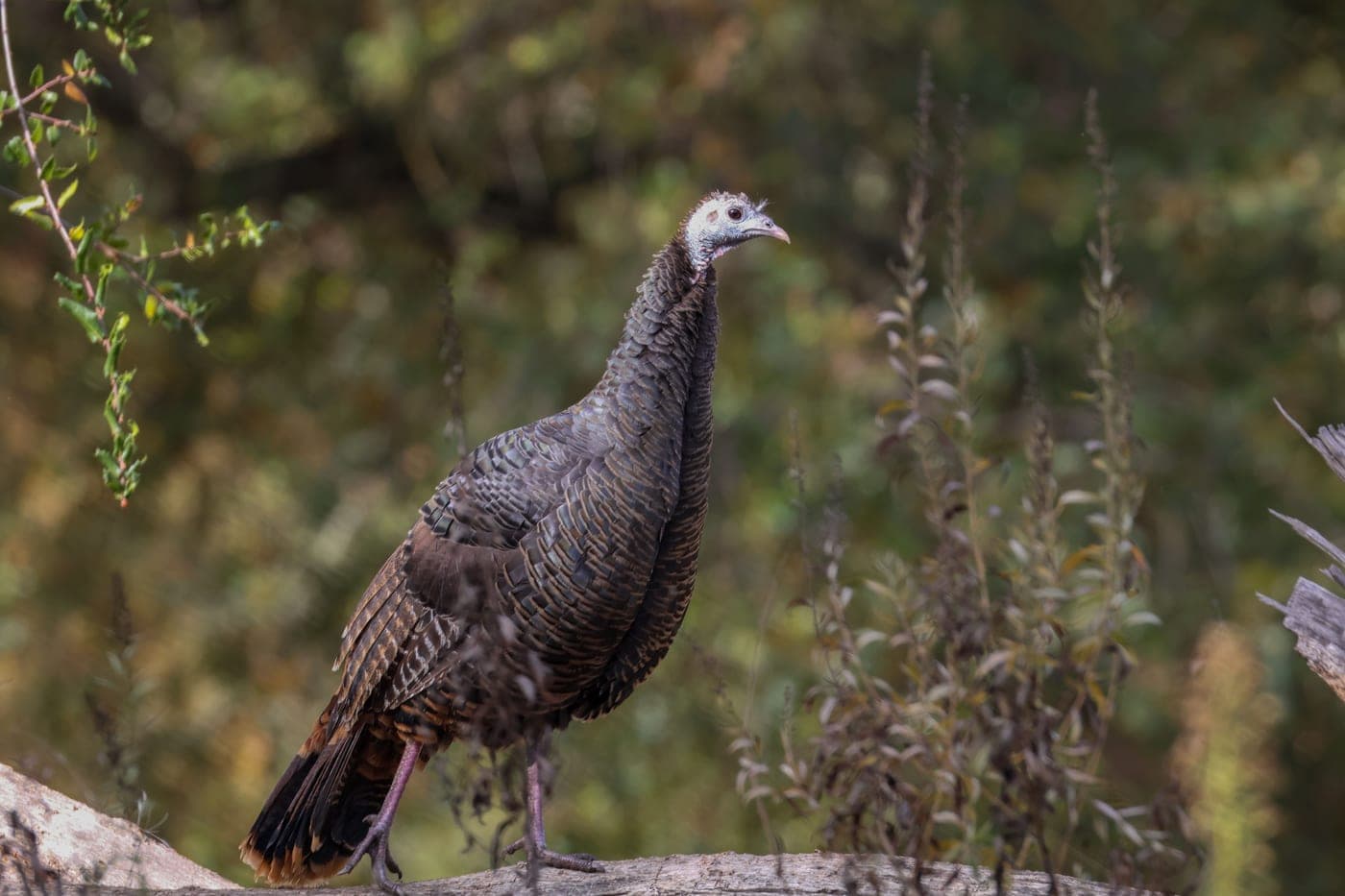
How turkeys talk, and how much of it you need
Wild turkeys don't have a big vocabulary, and a first-season hunter needs even less of it. This guide, part of our turkey calls hub, walks through each sound a turkey makes: what it sounds like, what it tells other turkeys, and which kind of call a beginner can use to copy it. The NWTF's beginner advice is to “learn the basic sounds like cluck, purr, putt and yelp, to start,” and that is the right order of business. You can fill in the rest over a few seasons.
Where this comes from: we haven't recorded these sounds or judged any call by ear. What a live turkey sounds like, and what each sound means, comes from two National Wild Turkey Federation guides, The Sounds of the Wild Turkey and What Does a Turkey Say? What a call can make comes from its maker's own product page. Where the two NWTF guides disagree on a detail, we show you both.
The turkey vocabulary at a glance
Every sound on this page in one table. The third column is what the sound tells other turkeys. The last column shows which of the three calls we pick further down (a box, a pot and a mouth call) lists that sound, according to its maker.
| Sound | What it sounds like | What it means | Listed by our picks |
|---|---|---|---|
| Plain yelp | A series of single-note calls | Basic turkey talk; “where are you” | ESH box, Slate Hammer pot, True Double mouth (“raspy yelps”) |
| Cluck | One or more short, staccato notes, often two or three | Getting another bird's attention; “come here” | All three |
| Purr | A soft, rolling call | Contentment; keeps a feeding flock in touch | ESH box, Slate Hammer pot |
| Cutt (cutting) | Loud, sharp clucks, often mixed with yelping | Excitement, not alarm | All three (ESH says “excited cutting”) |
| Tree yelp | Soft, muffled yelps from a roosted bird | Roost talk with nearby turkeys, by both sexes in all seasons | None of the three by name |
| Fly-down cackle | Loud, irregularly spaced notes: 3 to 10 (Sounds of the Wild Turkey) or 10 to 15 (What Does a Turkey Say?) | Leaving the roost; a hen on the ground | All three (cackles; Knight & Hale gives a cackle technique) |
| Assembly yelp | Loud yelps, more emphatic and longer than a standard series | A hen gathering her flock or poults | None of the three by name |
| Kee-kee | High-pitched whistling notes, usually three, lasting about two seconds | A lost young turkey trying to regroup | None of the three |
| Putt | A single sharp note or several | Alarm: the bird has seen or heard danger | None of the three |
| Gobble | A loud, rapid gurgling sound made by males | A male letting hens know he is there, mainly in spring | None of the three (two other box calls do; see below) |
Read down the last column and a pattern shows: the everyday sounds (yelp, cluck, purr, cutt, cackle) are exactly what mainstream box, pot and mouth calls are built around. The specialist sounds (kee-kee, gobble) need a specific call or a specific skill, and a beginner can safely leave them for later.
The four sounds to learn first: yelp, cluck, purr and cutt
The NWTF's starter list is cluck, purr, putt and yelp. We swap the cutt in for the putt in your practice time. The putt is an alarm call, and the NWTF's own advice is to have your shotgun “ready and on target” before you make one, so it belongs at the very end of a hunt. Cutting, on the other hand, is simply clucks run together fast, so it grows straight out of the cluck.
The yelp: “where are you?”
The NWTF calls the plain yelp “a basic turkey sound” that is “often delivered in a series of single note vocalizations,” and says it is “commonly used by a hen to communicate with a gobbler during mating season.” Its second guide boils the meaning down to “where are you,” a call that “can be used any time turkeys are separated.” Two variations are worth knowing by ear. The excited yelp is the same notes but “much more excited, rapid and with more volume.” The lost yelp “increases in urgency from note to note, with a perceptible rise in pitch.”
On a box call, Knight & Hale's instruction for its own two-sided box is to “slide the paddle across the body's lip in longer strokes in succession.” On its Slate Hammer pot call, the maker's yelp is a short oval or circular stroke in ½ in lines, 5 to 7 times, “producing a two-tone yelp.” On a mouth call, the NWTF's instruction is to make a whistle, then “slowly drop your jaw and/or tongue pressure.”
The cluck: “come here”
A cluck, per the NWTF, “consists of one or more short, staccato notes” and is “generally used by one bird to get the attention of another.” The plain cluck is “usually given singly or in a short series of two or three,” and both sexes use it to signal “come here.” For hunters, the NWTF says the cluck helps “reassure an approaching gobbler” and is worth trying when a bird “starts to hang up” out of range.
On a box: “Pop the paddle off the body's lip with short strokes” (Knight & Hale). On a pot, Knight & Hale says to move the striker very quickly in straight ¼ in lines with a popping motion. On a mouth call, the NWTF says to “huff a quick, forceful blast of air across the reeds.”
The purr: a relaxed bird
“Purring is a soft, rolling call turkeys make when content,” the NWTF writes: “a low vocal communication designed to keep the turkeys in touch and often is made by feeding birds.” Put a cluck in front of it and you have the cluck and purr, which the NWTF links to “flock talk or the feeling of contentment” and calls “good for reassuring turkeys as they get close to your position.” One exception: “Loud and rapid purrs may signal aggression as turkeys battle for dominance.” That's the fighting purr, a specialist sound Quaker Boy builds its Double Easy Yelper for (“great for fighting purrs”).
On a box, Knight & Hale says to “slowly slide the paddle across the body with little downward pressure.” On its pot call, a slow, straight 1 in line, and “hold striker higher for more consistent sound.” On a mouth call, the NWTF describes a “gargling sound in the back of your mouth as you huff air.” Note that Primos doesn't list purrs for the True Double mouth call we pick below.
The cutt: an excited bird
Cutting is “loud, sharp clucks that are often mixed with yelping,” and the NWTF is clear that it “is a sign that turkeys are excited, not alarmed.” Hunters cutt back at a cutting hen “in an attempt to bring her to you,” or use it “when you have tried soft calling to a gobbler that is hung up.” On a box, Knight & Hale simply says to “cluck repeatedly in fast numerous bursts.” On its pot call, the same quick ¼ in strokes “with broken rhythm (ex. 3 notes, 2 notes, 4 notes).”
Step-by-step technique for each call type lives in our how-to guides: how to use a box call (holding it, chalking it, the strokes), how to use a slate or pot call (striker angle and surface care) and how to use a mouth call (placement and air).
The rest of the vocabulary
Tree yelps and the fly-down cackle: the roost pair
The tree call is “a series of soft muffled yelps given by a roosted bird,” and the NWTF says hunters can use it “to let a gobbler on the roost know you are there.” Its second guide says tree yelps are “given by both sexes in all seasons from the roost” and calls them “excellent to use with a roosted gobbler at first light.” Keep them quiet: that's the whole point of the sound. Among the calls in our registry, H.S. Strut says its Push Button Yelper replicates “tree talk,” and WoodHaven lists tree yelps for its Ninja Ghost mouth call.
The cackle is the noise of a bird leaving the roost. The two NWTF guides count its notes differently: “three to 10 irregularly spaced notes, loud and staccato” in one, “10-15 irregularly spaced notes given as turkeys fly down from roost, cross stems or fly over fences” in the other. The NWTF calls the fly-down cackle a “good call to tell a gobbler that a hen is on the ground.” ESH lists “fly down cackles” for its All Weather box, and Knight & Hale's pot-call cackle is quick, straight ¼ in strokes, 7 to 10 times.
Assembly and lost yelps: gathering the flock
The hen assembly call is “a series of loud yelps, usually a little more emphatic and longer than a standard series of yelps,” used “to assemble her flock or young poults.” The NWTF says poults learn this “raspy call” within their first two days after hatching, that it works “in the fall when trying to call a scattered flock back together,” and that “loud assembly yelping in early season is very good on unseasoned gobblers.” The lost yelp is the answer from the other side: adults of both sexes give it “as they attempt to reassemble after being scattered.”
The kee-kee: a lost young bird
“The kee kee is usually a three-note call that lasts about two seconds,” the NWTF writes, and a kee-kee run “is merely a kee kee followed by a yelp.” It is “the call of lost young turkeys,” described in the second guide as “high pitched whistling notes.” It's mostly a fall sound: an NWTF fall-hunting article says a hunter who is good on a mouth call can add “kee-kees that are so popular with jakes in the fall.” None of our three picks lists it. In the registry, WoodHaven says its Fusion Aluminum pot call makes kee-kees with the included carbon striker, and Phelps says the Casper call in its Hunter's Select mouth-call pack makes “easy kee-kee runs.”
The putt: something is wrong
“The putt is a single or several sharp notes,” “generally associated as an alarm,” and it “usually means the bird has seen or heard something and is signaling danger.” The NWTF adds a useful shade of meaning: “Sharp clucks followed by purrs are not as serious of a warning as putts followed by silence.” If you hear putting as a bird comes in, the likeliest cause is something you did, usually movement. Our list of common first-season turkey hunting mistakes covers the usual culprits.
The gobble: the sound you're hunting
The gobble is “a loud, rapid gurgling sound made by male turkeys,” “used primarily in the spring to let hens know he is in the area.” The second NWTF guide says it serves to “attract females and repel competing males.” Some box calls can gobble: Primos says its Hook Up box, used with the included Gobble Band, makes gobbles, and Knight & Hale publishes a rubber-band shake technique for its HD Long Range Hen box.
Spring talk vs fall talk
The same birds use their vocabulary differently across the year. An NWTF fall article sums it up: “In the fall, turkeys are more interested in finding food, whereas in the spring, their thinking revolves around breeding.” In spring, hunters lean on hen sounds (yelps, clucks, purrs, cutting) to pull in a gobbler, and the gobble itself is mostly a spring sound. In fall, the flock sounds matter more: the assembly yelp, the lost yelp and the kee-kee, all built around scattered birds trying to find each other. Our fall vs spring turkey hunting comparison covers how the rest of the hunt changes, including which birds are legal.
Knowing the words isn't the same as talking
One more thing before you buy calls. An NWTF column on common calling errors describes callers who are “just making every sound they can think of without trying to communicate to the turkey.” The same column says “a smart hunter should call just enough to keep the bird gobbling.” A big vocabulary is useful for reading the woods: a putt tells you you've been spotted, a fly-down cackle tells you birds are hitting the ground. When it comes to making sounds yourself, a few right ones at the right moment beat all of them at once. Our guide to how often to call turkeys covers the timing side.
What to look for in a call that speaks the basics
- A maker that names the sounds. A call whose maker lists yelps, clucks, purrs and cutting tells you what it was built to do. “Makes all turkey talk” tells you nothing, and our published scoring rubric gives it the “not published” band.
- A call type you can run on day one. The NWTF says “beginners usually find a box call the easiest to get a consistent sound.” Our rubric scores the learning curve for push-button calls at 9, box calls 8, pot calls 6 and mouth calls 5 or lower.
- A soft end and a loud end. The purr and tree yelp are quiet; cutting is loud. A call that can do both covers the whole morning.
- A plan for rain. Traditional chalked box calls and slate pot calls carry no weather claim. Mouth calls don't mind rain, and some box calls carry a maker's rain claim.
- Skip the specialist sounds for now. You don't need a gobble tube or a kee-kee striker to start.
Our picks for this
One box, one pot, one mouth call for the core sounds
Each maker lists at least four of the sounds on this page. Start with the box; add the others as your ear and hands catch up.
- Illustrative photo
Best all-weather box call
ESH Custom Calls All Weather Turkey Box Call
Box call7.9/10ESH lists clucks, purrs, yelps, fly-down cackles and excited cutting, and says its coating keeps you calling in rain or shine. No published warranty.
Check price on Amazon#ad · Price set by Amazon · Disclosure for the link to ESH Custom Calls All Weather Turkey Box Call
- Illustrative photo
Best first slate call
Knight & Hale Slate Hammer Pot Call
Pot call6.7/10Knight & Hale lists yelps, clucks, cuts and purrs, prints technique for each plus the cackle, and calls it perfect for beginners. Slate has no weather claim.
Check price on Amazon#ad · Price set by Amazon · Disclosure for the link to Knight & Hale Slate Hammer Pot Call
- Illustrative photo
Best double reed for a first season
Primos True Double Turkey Call
Mouth call7.4/10Primos lists raspy yelps, clucks, cuts and cackles and calls it a very easy call to use. Purrs aren't on its list; learn a friction call first.
Check price on Amazon#ad · Price set by Amazon · Disclosure for the link to Primos True Double Turkey Call
Want more options in each type? Our rankings cover the field: the best box calls, the best slate and pot calls and the best mouth calls for beginners. If you only buy one call this year, make it the box.
How we picked this
Gear we claim to have field-tested: none
Plenty of turkey sites say they ran every call on the list all spring. We don't say that, and we say so on every page. What we do instead: read each maker's published specs, materials and instructions; note the sounds a maker says a call makes and how it says the call handles rain; check a choke's load ratings and thread chart; compare published weights, pockets and seat heights; and score all of it on a published rubric built around a first-season hunter. Every spec links to where it came from.
Scores are computed from that documented research with fixed bands, not field trials. Commissions never set a score or decide a pick. The rubric and its bands are published.
Questions
Frequently asked
What does turkey yelping mean?
The plain yelp is basic turkey communication. The NWTF says it means “where are you” and is used any time turkeys are separated, and that hens commonly use it to talk to gobblers during the breeding season.
Why do turkeys cluck and purr?
A cluck gets another bird's attention (“come here”), and a purr is the soft sound of a content, feeding bird. Together, the NWTF links the cluck and purr to flock talk and contentment, which is why hunters use it to reassure a bird that is close.
Do turkeys purr?
Yes. The NWTF describes purring as a soft, rolling call turkeys make when content, often while feeding. Loud, rapid purrs are different: the NWTF says they may signal aggression as turkeys fight for dominance.
What is the difference between yelping and cutting?
A yelp is a series of single notes, the everyday “where are you” call. Cutting is loud, sharp clucks often mixed with yelps, and the NWTF says it signals an excited turkey, not an alarmed one.
What does it mean when a turkey putts?
A putt is an alarm. The NWTF says it usually means the bird has seen or heard something and is signaling danger, and that putts followed by silence are a more serious warning than sharp clucks followed by purrs.
What is a kee-kee?
The call of a lost young turkey: high-pitched whistling notes, usually three, lasting about two seconds, per the NWTF. A kee-kee run is a kee-kee followed by a yelp. It's mostly used in fall, when broken-up flocks regroup.
Should a beginner use a gobble call?
Not as a first call. The NWTF warns hunters to be cautious using a gobble, especially on public land where it may attract other hunters. Learn the hen sounds first and save the gobble for private ground you know well.
Which turkey call can make all of these sounds?
A mouth call, in skilled hands. An NWTF fall article says a good slate call makes purrs, hen yelps and gobbler yelps, and a proficient mouth caller can add kee-kees. Mouth calls are also the hardest to learn, so most beginners start on a box.
Keep reading
Related on Strut & Slate
- How to use a box callThe strokes for yelps, clucks, purrs and cutting.
- How to use a slate callStriker angle, surface care and the two-tone yelp.
- How to use a mouth callPlacement, air and your first clean yelp.
- How often to call turkeysWhen to talk, and when to go quiet.
- Mouth call cuts explainedWhich reed cut suits which sound.
- Fall vs spring turkey huntingHow the calls and the legal birds change.
Receipts
Sources
- ESH Custom Calls (Outdoor Hunting Lab store) — ALL WEATHER Turkey Box Call product page, SKU AW-BOX-CALL2 (read 2026-09-22)
- ESH Custom Calls (Outdoor Hunting Lab store) — Refund Policy page (read 2026-09-22)
- Knight & Hale — Slate Hammer Pot Call (LBL Series) product page, SKU KHT0238 (read 2026-09-22)
- Knight & Hale — HD Long Range Hen Box Call product page, SKU KHT0207 (read 2026-09-22)
- Knight & Hale — Warranty Information page (read 2026-09-22)
- Primos — Hook Up Magnetic Turkey Call product page, SKU 259 (read 2026-09-22)
- Quaker Boy — Double Easy Yelper product page, #13606 (read 2026-09-22)
- H.S. Strut — Push Button Yelper product page, SKU HS-STR-07056 (read 2026-09-22)
- WoodHaven Custom Calls — Fusion Aluminum product page, SKU WH210 (read 2026-09-22)
- Primos — True Double Turkey Call product page, SKU PS108 (read 2026-09-22)
- Primos — Warranty page, general warranty coverage (read 2026-09-22)
- WoodHaven Custom Calls — Ninja Ghost mouth call product page, SKU WH093 (read 2026-09-22)
- Phelps Game Calls — Hunter's Select 3 Pack Turkey Calls product page, SKU PHTKTC3OCOS (read 2026-09-22)
- NWTF — The Sounds of the Wild Turkey (read 2026-09-22)
- NWTF — What Does a Turkey Say? (read 2026-09-22)
- NWTF — Turkey Hunting 101 (read 2026-09-22)
- NWTF — Calling Gaffes Turkey Hunters Keep Repeating, Brian Lovett (read 2026-09-22)
- NWTF — Mouth Call Madness, Brian Lovett (read 2026-09-22)
- NWTF — Call in a Turkey this Fall, Jason Houser (read 2026-09-22)
- Wisconsin DNR — Turkey Hunting (read 2026-09-22)
- Missouri Department of Conservation — Turkey: Regulations (read 2026-09-22)
We don't claim to have field-tested, owned or hunted with the products on this page. Specs come from the maker's own product pages and manuals (or a named dealer's copy when the maker's site blocked us), sound and performance claims are attributed to the maker, and any third-party observation is attributed to whoever made it. Amazon prices change often, so we don't print them. Where a figure isn't published, we say so and it earns the lowest band. Read the full method.