The contenders
Side by side
- Illustrative photo
Best for trying both seasons' calls
Primos Turkey Caller Starter Pak
Call kit5.8out of 10A box for spring, a slate pot call (the NWTF's pick for fall) and a mouth call to grow into, in one package. Primos publishes no sound list; check the contents on the listing.
Check price on Amazon#ad · Price set by Amazon · Disclosure for the link to Primos Turkey Caller Starter Pak
- Illustrative photo
Best single call for fall
Knight & Hale Slate Hammer Pot Call
Pot call6.7out of 10The NWTF says a quality slate call is the best for fall turkeys. Knight & Hale calls this one perfect for beginners and prints technique for five sounds. No weather claim.
Check price on Amazon#ad · Price set by Amazon · Disclosure for the link to Knight & Hale Slate Hammer Pot Call
- Illustrative photo
Best for a rainy spring morning
Quaker Boy H2O Easy Yelper
Push-button call7.9out of 10One-handed and waterproof per Quaker Boy, with no chalking. A spring hen call first; it isn't a kee-kee tool, and Quaker Boy names no specific sounds.
Check price on Amazon#ad · Price set by Amazon · Disclosure for the link to Quaker Boy H2O Easy Yelper
The verdict: spring first, for most beginners
This comparison sits in our first-season hub, which is built around a beginner's first spring, and that shapes the verdict: the hen sounds you learn for spring are the base the fall sounds build on. But fall seasons are open or about to open in some states as we publish this (Wisconsin's runs from Sept. 12, 2026 to Jan. 3, 2027), so if fall is what you can hunt this year, it is a perfectly good way in. We haven't hunted either season for this page. The bird behavior and calling advice come from the NWTF, and every rule quoted comes from two state agencies we read on 2026-09-22: the Missouri Department of Conservation and the Wisconsin DNR.
Fall vs spring turkey hunting, side by side
State rules in this table are examples, not a guide to your state. Read your own state wildlife agency's regulations before any season.
| Factor | Spring | Fall |
|---|---|---|
| What the birds are focused on | Breeding | Finding food |
| The sound that gives birds away | The gobble, used “primarily in the spring” | Flock talk: assembly yelps, lost yelps, kee-kees |
| Core calls | Hen yelps, clucks, purrs, cutting | Purrs, hen yelps and gobbler yelps on a slate; kee-kees for skilled mouth callers |
| Legal birds: Missouri | Male turkeys or turkeys with a visible beard | Two turkeys of either sex, archery and firearms combined |
| Legal birds: Wisconsin | One bearded or male turkey per spring harvest authorization | One turkey of any age or sex per fall harvest authorization |
| Dogs | Not legal in Wisconsin's spring season; prohibited in Missouri | Allowed statewide in Wisconsin with a fall authorization, stamp and license; prohibited in Missouri |
| Shooting hours: Missouri | Half hour before sunrise to 1 p.m. CDT on public land; to sunset on private land | Firearms: half hour before sunrise to sunset. Archery: to half hour after sunset |
| Season examples | Missouri regular season April 20 to May 10, 2026; Wisconsin's 2027 spring runs in six periods from April 21 | Missouri fall firearms Oct. 1 to 31, 2026; Wisconsin Sept. 12, 2026 to Jan. 3, 2027 |
Gobblers in spring, flocks in fall
An NWTF fall-hunting article puts the difference in one line: “In the fall, turkeys are more interested in finding food, whereas in the spring, their thinking revolves around breeding.” Everything else follows from that.
In spring, the gobbler is the one making noise. The NWTF says the gobble is used “primarily in the spring to let hens know he is in the area,” and that hens commonly yelp to gobblers “during mating season.” The spring hunt turns that around: you sound like a hen, he comes looking. It's a sit-still, call-and-wait hunt, which suits a beginner who is still learning to be patient and quiet.
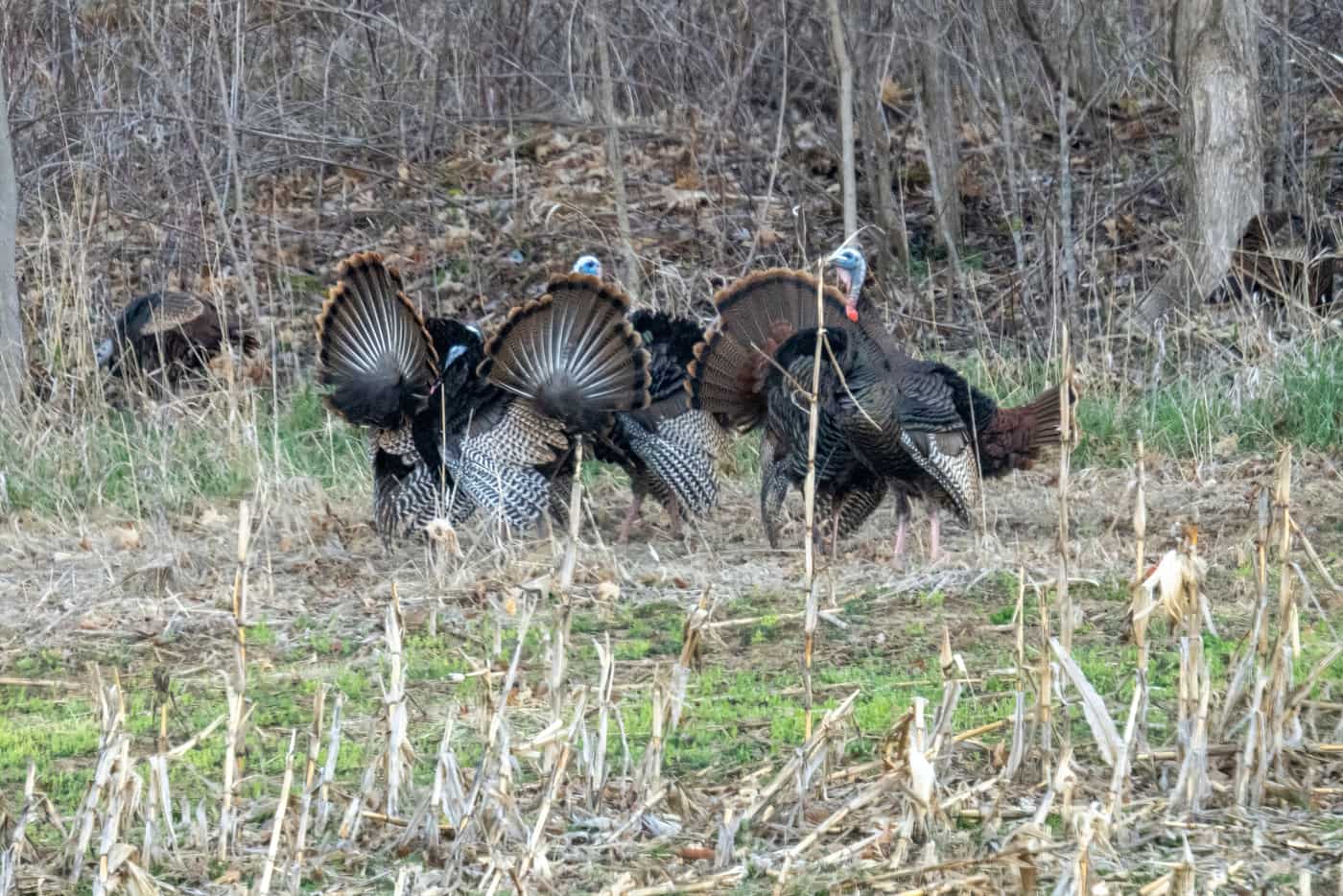
In fall, the flock is the unit. The NWTF's sound guide says the hen assembly call works “in the fall when trying to call a scattered flock back together,” and that the kee-kee run, “the call of lost young turkeys,” is used “to reassemble a scattered flock.” Fall hunters are often trying to find where a flock is feeding and call broken-up birds back together. Because either-sex birds are legal in fall in the two states we read, you'll see hens, young birds and gobblers together, and bag limits still apply. Our guide to jake vs tom vs hen identification covers how to tell them apart, which matters even more in a spring season restricted to bearded birds.
How calling changes between seasons
Spring calling runs on four hen sounds: the yelp, cluck, purr and cutt. If those are new to you, our guide to turkey calls and what they mean covers each one. The NWTF's beginner guide says to learn the cluck, purr, putt and yelp first and to “start soft and slow with your calls.”
Fall calling uses some of the same sounds and adds others. The NWTF article Call in a Turkey this Fall says “the best for fall turkeys is a quality slate call” and that “with a good slate call, a hunter can make realistic purrs, hen yelps and even gobbler yelps.” A hunter good on a mouth call, it adds, can also make “kee-kees that are so popular with jakes in the fall.” Its cadence advice is simple: “When a turkey calls, call back with the same; just be more excited.”
Another NWTF writer, in Overlooked Fall Calls, says he holds off on kee-kees “until I get a flock scattered or get one to answer with a kee-kee, and then I do it back,” and uses “a slow yelp with a couple of clucks” later in the fall. He also reports good luck on fall gobblers “just gobbling,” which carries the same caution as in spring: the NWTF warns that a gobble “may attract fellow hunters,” especially on public land.
The practical upshot for a beginner: a box call is the easiest spring call, and a slate or pot call earns its place in both seasons. Our slate and pot call rankings compare the surfaces.
The rules change by season and by state
Turkey rules don't just change from state to state. They often change between seasons in the same state. Here is how far apart two Midwest states can be.
Which season to start with
For most beginners, we'd start in spring, for three reasons. The hunt is simpler to describe and to learn: one bird that announces himself, a tree to sit against, a handful of hen sounds. The NWTF's beginner material, from call choice to “start soft and slow,” is written around it. And the skills carry forward, since the fall slate call the NWTF recommends makes the same purrs and hen yelps you practiced for spring. Our pillar guide on how to turkey hunt for beginners walks through that first spring from license to the shot.
Fall is the better first season in a few cases: your state offers fall and you don't want to wait, you bowhunt (Missouri, for example, runs fall archery from Sept. 15 to Nov. 13 and again from Nov. 25, 2026 to Jan. 15, 2027), or you have a mentor who hunts fall flocks. One more spring wrinkle to know before you plan: in Missouri, spring hunting on public land ends at 1 p.m., which rules out an evening hunt there. Our turkey hunting morning vs evening comparison covers when each half of the day makes sense.
Calls that work in both seasons
These three beginner calls come from our registry, scored on our published rubric from maker specs; we haven't hunted with any of them. Every value below links to its source, and a dash means the maker doesn't publish it.
| Evidence | Primos Turkey Caller Starter Pak | Knight & Hale Slate Hammer Pot Call | Quaker Boy H2O Easy Yelper |
|---|---|---|---|
| Type | Starter call kit: box call, slate pot call and mouth call | Pot call | Push-button friction call; "one-handed, simple operation" (per Quaker Boy) |
| Surface | — | Slate | — |
| Sounds (per maker) | Not published | Yelps, clucks, cuts, purrs; the technique section also covers the cackle (per Knight & Hale) | Not published |
| Weather | Not published | No weather claim (slate surface) | "Waterproof"; coating "allows the H20 to work in the heaviest rain storms"; "requires no chalking" (per Quaker Boy) |
| Included | Sonic Dome Mouth Call, Sonic Dome Slate Call, Slim Striker and a double-sided box call (per Primos; Sportsman's Warehouse also lists a conditioning kit and carrying case, which Primos does not) | Hickory striker, scouring pad | — |
| Score | 5.8/10 | 6.7/10 | 7.9/10 |
- Primos Turkey Caller Starter Pak: the one purchase that covers both seasons. Primos lists a double-sided box call, a Sonic Dome slate call with a Slim Striker and a Sonic Dome mouth call, and says the pack is “great for beginners and advanced hunters.” The box is your spring call, the slate is the NWTF's fall pick, and the mouth call is there when you're ready. Primos publishes no sound list or materials, and a retailer lists extra items Primos doesn't, so confirm the contents on the listing. It scores 5.8, lowest of the three, mostly because so little is published.
- Knight & Hale Slate Hammer: a single slate pot call that fits the NWTF's fall advice and spring basics. Knight & Hale says it is “perfect for beginners,” comes at “an economical price point,” and lists yelps, clucks, cuts and purrs, with a cackle technique too. Slate carries no weather claim, so keep it dry.
- Quaker Boy H2O Easy Yelper: the spring specialist. Quaker Boy calls it the “easiest call to operate” and waterproof enough for “the heaviest rain storms.” It is a one-handed hen call, not a fall flock tool, and Quaker Boy names no specific sounds for it. It's the top scorer here at 7.9.
None of the three lists a kee-kee. If you want one for fall, WoodHaven says its Fusion Aluminum pot call makes kee-kees with the included carbon striker; it's a premium custom-shop call with no beginner claim. For the full field, see our best turkey calls for beginners and our push-button turkey call rankings.
In detail
The contenders, in full
Best for trying both seasons' calls
Primos Turkey Caller Starter Pak
A box for spring, a slate pot call (the NWTF's pick for fall) and a mouth call to grow into, in one package. Primos publishes no sound list; check the contents on the listing.
Spec sheetSourced · not field-tested by us
How the 5.8 score breaks down
- Beginner learning curve (30%)
- 9
- Sound range (20%)
- 4
- Weather tolerance (20%)
- 4
- Build & materials (15%)
- 5
- Carry & vest noise (15%)
- 5
What the specs support
- All three call types in one box (box, slate pot with striker and a diaphragm), so a beginner can find out which one they run best.
- Primos markets it directly at new hunters: "Great for beginners and advanced hunters."
- The box call is double-sided (per Primos).
- Backed by Primos's 1-year defect warranty.
Where it falls short
- Primos publishes no sounds, materials or dimensions for any call in the kit.
- Neither the box nor the slate carries a weather claim, so rain is a concern for the two friction calls.
- Retailer listings describe the contents differently from Primos (one adds a conditioning kit and carrying case), so check the contents on the listing before you buy.
Skip this if…
…you already own a box or pot call you like; you would be paying for duplicates, so buy a single mouth call instead.
#ad · Price set by Amazon · Disclosure for the link to Primos Turkey Caller Starter Pak
Best single call for fall
Knight & Hale Slate Hammer Pot Call
The NWTF says a quality slate call is the best for fall turkeys. Knight & Hale calls this one perfect for beginners and prints technique for five sounds. No weather claim.
Spec sheetSourced · not field-tested by us
| Category | Pot call |
|---|---|
| Type | Pot call |
| Sounds (per maker) | Yelps, clucks, cuts, purrs; the technique section also covers the cackle (per Knight & Hale) |
| Surface | Slate |
| Striker | Hickory (included) |
| Material | Durable, injection-molded polymer pot |
| Weather | No weather claim (slate surface) |
| Weight | Not published |
| Included | Hickory striker, scouring pad |
| Warranty | Standard 1-year from date of purchase; excludes weather-related conditions (Knight & Hale warranty page) |
How the 6.7 score breaks down
- Beginner learning curve (30%)
- 7
- Sound range (20%)
- 8
- Weather tolerance (20%)
- 5
- Build & materials (15%)
- 7
- Carry & vest noise (15%)
- 6
What the specs support
- Knight & Hale calls it "perfect for beginners" and says it comes at "an economical price point."
- True slate surface, the one Knight & Hale describes as making "natural, clear" yelps, clucks, cuts and purrs.
- Polymer pot built for "difficult terrain where a call may be damaged" (per Knight & Hale).
- Striker and scouring pad included, plus a 1-year warranty.
Where it falls short
- Slate has no weather claim here; wet slate is the classic friction-call weak spot.
- Polymer pot rather than wood.
- Only one striker in the box.
Skip this if…
…you expect to call in steady rain; this slate surface carries no weather claim, while the WoodHaven Fusion Aluminum is built for wet days.
#ad · Price set by Amazon · Disclosure for the link to Knight & Hale Slate Hammer Pot Call
Best for a rainy spring morning
Quaker Boy H2O Easy Yelper
One-handed and waterproof per Quaker Boy, with no chalking. A spring hen call first; it isn't a kee-kee tool, and Quaker Boy names no specific sounds.
Spec sheetSourced · not field-tested by us
How the 7.9 score breaks down
- Beginner learning curve (30%)
- 10
- Sound range (20%)
- 4
- Weather tolerance (20%)
- 9
- Build & materials (15%)
- 7
- Carry & vest noise (15%)
- 8
What the specs support
- Quaker Boy calls it the "easiest call to operate for today's turkey hunter."
- Waterproof coating for "the heaviest rain storms," with no chalking (per Quaker Boy).
- Quaker Boy says it "carries loud and clear" in wind.
- One-handed operation.
Where it falls short
- Quaker Boy lists no specific sounds for it.
- One voice only; a single push-button won't make a fighting purr.
- No published warranty term.
Skip this if…
…you want a call with a long, documented list of sounds; Quaker Boy names none for the H2O.
#ad · Price set by Amazon · Disclosure for the link to Quaker Boy H2O Easy Yelper
How we picked this
Gear we claim to have field-tested: none
Plenty of turkey sites say they ran every call on the list all spring. We don't say that, and we say so on every page. What we do instead: read each maker's published specs, materials and instructions; note the sounds a maker says a call makes and how it says the call handles rain; check a choke's load ratings and thread chart; compare published weights, pockets and seat heights; and score all of it on a published rubric built around a first-season hunter. Every spec links to where it came from.
Scores are computed from that documented research with fixed bands, not field trials. Commissions never set a score or decide a pick. The rubric and its bands are published.
Corrections & updates
- First published. Specs read from maker pages and state rules read from agency pages 2026-09-22.
Questions
Frequently asked
Is fall or spring turkey hunting better for beginners?
For most beginners, spring: you call a gobbler to you with basic hen sounds, and most beginner advice is built around that hunt. Fall is a good start if your state offers it and you want to hunt flocks, often with either-sex birds legal.
Can you shoot hens in the fall?
In some states, yes. Missouri allows two turkeys of either sex in its fall seasons, and Wisconsin allows one turkey of any age or sex per fall harvest authorization. Rules vary, so check your state wildlife agency.
What calls work for fall turkey hunting?
An NWTF fall article calls a quality slate call the best for fall turkeys, since it makes purrs, hen yelps and gobbler yelps. Skilled mouth callers can add kee-kees, the call of lost young birds trying to regroup.
How many states have a fall turkey season?
The NWTF says more than 40 states have a fall season. Dates, legal birds and methods differ by state and sometimes by zone, so read your own state's regulations.
Can you hunt turkeys with dogs in the fall?
Only where your state allows it. Wisconsin lets hunters with the required fall authorization, stamp and license use dogs statewide during the fall season but not in spring. Missouri prohibits dogs for turkey hunting.
Is turkey behavior different in fall and spring?
Yes. Per the NWTF, fall turkeys are more interested in finding food, while spring birds are focused on breeding. That's why spring hunters call gobblers with hen sounds and fall hunters work flocks with assembly yelps and kee-kees.
Keep reading
Related on Strut & Slate
- Best turkey calls for beginnersEvery call type ranked for a first season.
- How to turkey hunt for beginnersThe first spring, from license to the shot.
- Turkey hunting morning vs eveningWhen each half of the day works.
- Turkey calls and what they meanThe spring and fall vocabulary.
- Jake vs tom vs henKnow which bird is legal before you shoot.
- Best slate callsThe pot calls that work in both seasons.
Receipts
Sources
- Primos — Turkey Caller Starter Pak product page, SKU 272 (read 2026-09-22)
- Sportsman's Warehouse — Primos Turkey Calling Starter Kit listing, MPN 272 (read 2026-09-22)
- Primos — Warranty page, general warranty coverage (read 2026-09-22)
- Knight & Hale — Slate Hammer Pot Call (LBL Series) product page, SKU KHT0238 (read 2026-09-22)
- Knight & Hale — Warranty Information page (read 2026-09-22)
- Quaker Boy — H2O Easy Yelper product page, #13608 (read 2026-09-22)
- Quaker Boy — Return Policy page (read 2026-09-22)
- WoodHaven Custom Calls — Fusion Aluminum product page, SKU WH210 (read 2026-09-22)
- WoodHaven Custom Calls — Returns & Shipping page (read 2026-09-22)
- NWTF — Call in a Turkey this Fall, Jason Houser (read 2026-09-22)
- NWTF — Overlooked Fall Calls, Brian Lovett (read 2026-09-22)
- NWTF — The Sounds of the Wild Turkey (read 2026-09-22)
- NWTF — Turkey Hunting 101 (read 2026-09-22)
- Missouri Department of Conservation — Turkey: Regulations (read 2026-09-22)
- Wisconsin DNR — Turkey Hunting (read 2026-09-22)
We don't claim to have field-tested, owned or hunted with the products on this page. Specs come from the maker's own product pages and manuals (or a named dealer's copy when the maker's site blocked us), sound and performance claims are attributed to the maker, and any third-party observation is attributed to whoever made it. Amazon prices change often, so we don't print them. Where a figure isn't published, we say so and it earns the lowest band. Read the full method.