The contenders
Side by side
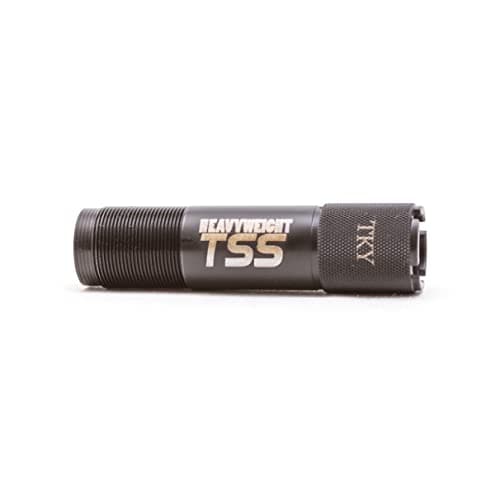
20 gauge: the TSS tube to start with
Carlson's TSS Turkey Choke Tube, 20 Gauge
Turkey choke7.2out of 10Carlson's TSS tube in 20 ga, a 0.555 in exit (0.565 in for Invector Plus) for 5 thread systems including Winchester/Browning Invector/Mossberg 500 and Remington, optimized for Federal Heavyweight TSS and backed by a lifetime warranty.
$49.33Amazon#ad · Price as of November 2, 2026 · Disclosure for the link to Carlson's TSS Turkey Choke Tube, 20 Gauge
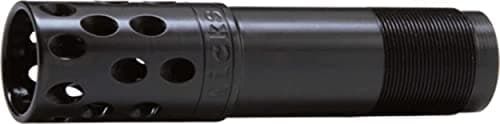
20 gauge: ported, rated for lead and TSS
Kick's Gobblin' Thunder Turkey Choke Tube, 20 Gauge
Turkey choke8.7out of 10The 20 ga version of Kick's extended, ported 17-4 stainless turkey tube, rated by Kick's for lead, TSS and other non-toxic loads, in 0.560 or 0.570 in exits across 12 thread versions.
$52.90Amazon#ad · Price as of November 2, 2026 · Disclosure for the link to Kick's Gobblin' Thunder Turkey Choke Tube, 20 Gauge
- Carlson's Choke TubesNo image
.410: the TSS tube with two lengths
Carlson's TSS Turkey Choke Tube, .410
Turkey choke7.0out of 10Carlson's .410-only TSS tube at 0.385 in for its Long Invector thread (which Carlson's says fits the Browning BPS/Citori, CVA Scout, Henry and Mossberg 500) and Short Invector thread (Stevens 301), plus a Beretta/Benelli Mobil version, optimized for Federal Heavyweight TSS.
Check price on Amazon#ad · Price as of November 2, 2026 · Disclosure for the link to Carlson's TSS Turkey Choke Tube, .410
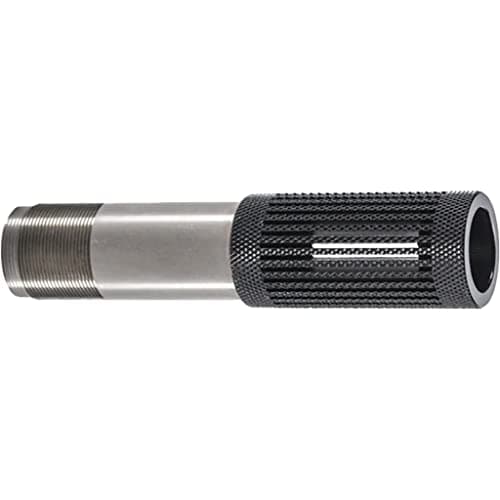
.410: five thread models named
Indian Creek Black Diamond Turkey Choke Tube, .410
Turkey choke7.0out of 10Indian Creek's ported, hand-tightened .410 turkey tube, offered at 0.385 and 0.390 in across five thread models that between them name the Stevens 301, Mossberg 500, CVA Scout, Henry, Rossi, TriStar and Yildiz, rated for lead and hybrid heavy loads from #2 through #10 shot.
$98.99Amazon#ad · Price as of November 2, 2026 · Disclosure for the link to Indian Creek Black Diamond Turkey Choke Tube, .410
What you actually give up
This is a payload argument, not a velocity argument. A smaller bore carries fewer pellets, and pellets in a 10 in circle are the whole game in turkey hunting, because you are aiming at a head and neck rather than a body.
What rescued both of these gauges is density, not the guns. Apex Ammunition publishes Tungsten Super Shot at 18.1 g/cc against lead at 11.34 g/cc, and the NWTF puts the same comparison at 56 percent denser than lead. That density is why a pellet small enough to fit a useful number into a .410 hull still carries enough energy at 40 yards to break a gobbler's neck. Lead in a .410 does not get there, and that is not a close call. The full argument is in TSS vs lead turkey loads.
The 20 gauge has the same tungsten option and more room to use it, which is the entire comparison in one sentence. The .410 needs TSS to be viable; the 20 gauge is viable with lead and better with TSS.
The published pellet counts
The number worth knowing is the one the NWTF publishes in its own work on the .410 for turkeys: TSS .410 guns averaging 125 to 150 pellets in a 10 in circle at 40 yards. That clears the long-standing 100-pellet benchmark that turkey hunters have used for decades, and it is why the .410 stopped being a joke in this context.
Recoil, and the shooter in front of you
Most people asking this question are asking it on behalf of a young hunter, and the answer there is well established. Missouri's Department of Conservation, in its own guidance on turkey hunting equipment, points young and smaller-framed hunters at 20 gauges. That is a state agency recommending the 20, not a magazine.
The .410 recoils less still, and for a genuinely recoil-sensitive shooter that is a real advantage: a flinch costs more birds than a gauge does. But the trade is a tighter yardage leash and a shorter list of shells and chokes to buy. If you are kitting out a kid, read best youth turkey shotguns alongside this page, and put the saved money into a patterning session and a seat they will sit still in.
One practical note that has nothing to do with ballistics: a youth-sized gun that fits is worth more than a gauge choice. A 20 gauge that is too long in the stock will get shot badly.
Choke choice is not equal
This is the part buyers underestimate. The 20 gauge has a deep bench of turkey tubes; the .410 has a short one, and the first question is whether your .410 is even threaded for a choke at all — many single-shots and older guns are not, which we cover in .410 for turkey hunting.
- 20 gauge: our registry carries TSS-rated and lead-rated tubes from Carlson's, Kick's, Indian Creek and Primos, in multiple constrictions per thread. The ranking is in best 20 gauge turkey chokes.
- .410: fewer makers, fewer threads, and usually one or two exit diameters. The ranking is in best .410 turkey chokes.
Fewer constrictions means fewer chances to fix a pattern without buying different shells. With a 20 gauge you can chase a tighter core by changing the tube; with a .410 you are more likely to be changing the load.
Four tubes, two gauges
Two tubes per gauge, read off the makers' own pages. Note how the published rated-load lines differ: that is the single most important column on this table if you intend to shoot tungsten.
What your state says about shot and gauge
Which to buy
If you are buying one gun for a first turkey season, buy the 20 gauge. It has the payload margin, the choke choice, the load choice and an agency recommendation behind it for young shooters, and nothing about it is unpleasant to shoot with modern turkey loads. The 20-against-12 version of this question, which is the next one most people ask, is in 20 gauge vs 12 gauge for turkey.
If recoil is the real constraint, the .410 is a legitimate turkey gun now in a way it was not fifteen years ago — on three conditions, all of them non-negotiable: tungsten shot, a .410 turkey choke, and a range ceiling set by your own paper target rather than by a box claim. Mississippi State Extension's patterning publication is the procedure; ours is in how to pattern a turkey gun.
One last thing that applies to both: a small gauge makes your setup matter more. Decoys at a known distance and a bird that has to walk inside 30 yards do more for a .410 hunter than any choke, and that is a free upgrade — see how to set up turkey decoys and where to aim on a turkey.
Legal means are a state question as well as a ballistics one — the East Zone in Texas, for instance, is limited to shotgun and lawful archery equipment. The zone-by-zone rules are in turkey hunting in Texas.
In detail
The contenders, in full
20 gauge: the TSS tube to start with
Carlson's TSS Turkey Choke Tube, 20 Gauge
Carlson's TSS tube in 20 ga, a 0.555 in exit (0.565 in for Invector Plus) for 5 thread systems including Winchester/Browning Invector/Mossberg 500 and Remington, optimized for Federal Heavyweight TSS and backed by a lifetime warranty.
Spec sheetEvery row sourced to the maker
How the 7.2 score breaks down
- Load compatibility (30%)
- 8
- Constriction options (20%)
- 5
- Thread fit coverage (20%)
- 7
- Build & porting (15%)
- 8
- Maker guidance (15%)
- 8
What the specs support
- Carlson's says the Heavyweight TSS pairing makes TSS "ideal for .410, 20ga, and 12ga," and names the load it is tuned for.
- Covers the 20 ga Mossberg 500 by name (Win/Browning Inv/Moss 500 20ga, item 38008).
- Lifetime warranty; made in the USA.
Where it falls short
- One exit diameter per thread.
- Rated for 7-9 TSS shot; no lead load named.
- Only 5 thread systems in 20 ga.
Skip this if…
…you shoot lead in your 20 gauge; this tube is built for 7-9 TSS shot, and Carlson's Long Beard 20 ga is the maker's lead-load option.
#ad · Price as of November 2, 2026 · Disclosure for the link to Carlson's TSS Turkey Choke Tube, 20 Gauge
20 gauge: ported, rated for lead and TSS
Kick's Gobblin' Thunder Turkey Choke Tube, 20 Gauge
The 20 ga version of Kick's extended, ported 17-4 stainless turkey tube, rated by Kick's for lead, TSS and other non-toxic loads, in 0.560 or 0.570 in exits across 12 thread versions.
Spec sheetEvery row sourced to the maker
How the 8.7 score breaks down
- Load compatibility (30%)
- 10
- Constriction options (20%)
- 6
- Thread fit coverage (20%)
- 9
- Build & porting (15%)
- 10
- Maker guidance (15%)
- 8
What the specs support
- Rated by Kick's for lead and TSS, which matters in 20 ga, where TSS is what stretches the range.
- Two exit diameters (0.560 and 0.570 in) in the common threads.
- 17-4 stainless, extended, ported and finger-tight (per Kick's).
- Sold in 12 separate 20 ga thread versions.
Where it falls short
- No warranty terms published.
- Kick's lists an Invector 20 ga version but does not name the Mossberg 500 on its own site.
- No weight published.
Skip this if…
…your 20 gauge is a Mossberg 500 and you want the maker to confirm the fit; Carlson's and Indian Creek both name the 20 ga Mossberg 500 on their charts, Kick's does not.
#ad · Price as of November 2, 2026 · Disclosure for the link to Kick's Gobblin' Thunder Turkey Choke Tube, 20 Gauge
.410: the TSS tube with two lengths
Carlson's TSS Turkey Choke Tube, .410
Carlson's .410-only TSS tube at 0.385 in for its Long Invector thread (which Carlson's says fits the Browning BPS/Citori, CVA Scout, Henry and Mossberg 500) and Short Invector thread (Stevens 301), plus a Beretta/Benelli Mobil version, optimized for Federal Heavyweight TSS.
Spec sheetEvery row sourced to the maker
How the 7.0 score breaks down
- Load compatibility (30%)
- 8
- Constriction options (20%)
- 5
- Thread fit coverage (20%)
- 6
- Build & porting (15%)
- 8
- Maker guidance (15%)
- 8
What the specs support
- A .410-specific TSS tube; Carlson's page names the Mossberg 500 .410 on the Long Invector version.
- Tuned to Federal Heavyweight TSS, the load Carlson's calls ideal in .410.
- Lifetime warranty; made in the USA.
Where it falls short
- No .410 Remington 870 (Pro Bore) version, per Carlson's interchange guide.
- One exit diameter per thread.
- An Amazon listing labels item 38030 (Short Invector) as "Mossberg 500"; Carlson's own page puts the Mossberg 500 on the Long Invector (38032), so check the item number.
Skip this if…
…your .410 is a Remington 870; Carlson's interchange guide says it does not make that Pro Bore tube.
#ad · Price as of November 2, 2026 · Disclosure for the link to Carlson's TSS Turkey Choke Tube, .410
.410: five thread models named
Indian Creek Black Diamond Turkey Choke Tube, .410
Indian Creek's ported, hand-tightened .410 turkey tube, offered at 0.385 and 0.390 in across five thread models that between them name the Stevens 301, Mossberg 500, CVA Scout, Henry, Rossi, TriStar and Yildiz, rated for lead and hybrid heavy loads from #2 through #10 shot.
Spec sheetEvery row sourced to the maker
How the 7.0 score breaks down
- Load compatibility (30%)
- 7
- Constriction options (20%)
- 6
- Thread fit coverage (20%)
- 8
- Build & porting (15%)
- 6
- Maker guidance (15%)
- 8
What the specs support
- Two exit diameters, 0.385 and 0.390 in, so a disappointing pattern board does not mean changing brands.
- Five thread models, and the fitment table names the two guns most first-season .410 hunters own: the Stevens 301 (#0041) and the Mossberg 500 (#0046).
- Ported and hand-tightened, with a published 40-yard patterning process behind it.
Where it falls short
- Not rated for TSS by Indian Creek, which is awkward in a bore where tungsten is the only load worth shooting.
- Material not named anywhere on the .410 page.
- Amazon listings label the .410 tubes "Black Diamond" while Indian Creek's own page title is ".410 Turkey Choke Tubes" under the Black Diamond Strike line, so match the model number, not the listing title.
Skip this if…
…you want the maker's own page to say the tube is rated for TSS before you load tungsten through it; Carlson's and Primos both do and Indian Creek does not.
#ad · Price as of November 2, 2026 · Disclosure for the link to Indian Creek Black Diamond Turkey Choke Tube, .410
How we picked this
Scored on the specs that decide your season
Every pick is read off the maker's own specs, materials and instructions, then scored on a public rubric built around a first-season hunter: the sounds a call is made to produce and how it holds up in rain, a choke's load ratings and thread chart, the weights, pockets and seat heights you carry all morning. Each figure links straight to the page it came from, so you can check any pick in one click.
Scores come from that documented research with fixed bands, and prices come live from Amazon with the date they were checked. Commissions never set a score or decide a pick. The rubric and its bands are published.
Corrections & updates
- First published. Pellet-count figures from the NWTF, density figures from Apex Ammunition, youth-gauge guidance from the Missouri Department of Conservation.
Questions
Frequently asked
Is a .410 or 20 gauge better for turkey hunting?
The 20 gauge, for almost everyone. It carries more shot, has far more choke and load options, and Missouri's Department of Conservation points young hunters at 20 gauges. The .410 is the better answer only when recoil sensitivity is the deciding factor, and then only with tungsten shot and a 40-yard discipline.
Can a .410 kill a turkey at 40 yards?
With TSS, a .410 turkey choke and a patterned gun, yes: the NWTF reports .410 TSS guns averaging 125 to 150 pellets in a 10 in circle at 40 yards, which clears the 100-pellet benchmark. With lead shot, no. And 40 yards is a ceiling, not a target distance.
Is a 20 gauge enough for turkey?
Yes. It is a mainstream turkey gauge, not a compromise, and modern 20 gauge turkey loads in both lead and tungsten are widely available. The limits are the same ones a 12 gauge has: pattern the gun, know your range and aim at the head and neck.
Does a .410 need a special choke for turkey?
It needs a .410 turkey choke, and first it needs a barrel that is threaded for one — many .410s are not. Our .410 choke ranking covers the thread models the makers actually publish, including the Stevens 301 and Mossberg 500 fits.
What shot size for a .410 turkey load?
Tungsten loads use much smaller pellets than lead because the density does the work, and legal shot sizes are set by your state rather than by the shell maker. Read your current regulations digest, then pattern the exact shell you intend to hunt with.
Which gauge is best for a kid's first turkey?
A 20 gauge that fits them, in most cases: light recoil with real payload. Drop to a .410 if the 20 still produces a flinch. Fit matters more than gauge — a gun with too long a stock gets shot badly whatever the bore.
Keep reading
Related on Strut & Slate
Receipts
Sources
- NWTF — Are .410 Shotguns Ready for Turkey Hunting? (read 2026-09-22)
- Apex Ammunition — The TSS Difference (read 2026-09-22)
- Missouri Department of Conservation — Turkey Hunting Equipment (read 2026-09-22)
- Missouri Department of Conservation — Turkey: Regulations (read 2026-09-22)
- New York State DEC — Turkey Hunting Regulations (read 2026-09-22)
- Mississippi State University Extension — How to Pattern a Shotgun for Turkey Hunting (P3234) (read 2026-09-22)
- NWTF — Is the Age-Old Pattern Rule Still Viable? (read 2026-09-22)
- Carlson's Choke Tubes — Choke Tube Information page: 17-4 PH stainless, patterning information, turkey choke chart by load size (read 2026-09-22)
- Kick's Industries — Gobblin' Thunder Turkey Choke Tubes page (17-4 PH, ported, lead/TSS statement, choke selector) (read 2026-09-22)
- Indian Creek Shooting Systems — Choke Tubes page (Black Diamond Strike, Triumph, Assault) (read 2026-09-22)
- Indian Creek Shooting Systems — Interchange page (read 2026-09-22)
Every spec on this page comes from the maker's own product pages and manuals (or a named dealer's copy where the maker's site blocked us), with sound and performance claims attributed to the maker and any third-party observation attributed to whoever made it. Prices come live from Amazon with the date they were checked. Where a maker leaves a figure unpublished, the page says so and that spec earns the lowest band. Read the full method.