The steps at a glance
- Hold the call in your off hand (or clip it to the gun) with the plunger pointing toward you and your index finger resting on it.
- Push with a short, even stroke — about an inch on a Knight & Hale HD Cutter — and let the spring return it. Do not force the return.
- Make a yelp with 5 to 10 strokes in a row, starting slightly faster and slowing at the end, which is the cadence of a real hen yelp.
- Make a cluck with one short, light stroke, and a purr with a very slow, soft stroke.
- Cut by running several short strokes fast and irregularly, then stop dead.
- Then be quiet. Put the call down in your lap and listen before you call again.
That is the entire technique. The reason this call exists is that every other friction call needs two hands and several evenings of practice first; a push-button is the call you can hand a 10-year-old or a first-timer on opening morning. H.S. Strut says its push-button yelper makes turkey sounds “without the large learning curve associated with some turkey calls,” and Knight & Hale calls its push/pull “one of the easiest calls to use” and “great for kids, beginners, and seasoned hunters.”
What is actually happening inside
A push-button call is a friction call with the geometry fixed for you. Inside the box is a wooden paddle or lid held against a sounding edge by a spring-loaded dowel. When you push the plunger, the dowel drags the paddle across that edge and the edge vibrates — the same physics as a box call, except the angle, the pressure and the travel are all set by the maker instead of by your hand.
That is why the call sounds right immediately and why it sounds the same every time. It is also why it has a limited vocabulary: you can change how far and how fast you push, but you cannot change the contact angle the way you can by tilting a box call. Quaker Boy builds its Easy Yelper from mahogany sides, a maple striker, a birch dowel and a stainless steel spring, and calls the whole thing “one handed, simple operation.”
If you want to understand what you are imitating, the NWTF's rundown of the sounds of the wild turkey is the reference, and our own turkey calls and what they mean matches each sound to what the bird is saying.
How to hold it, and where to mount it
The point of a push-button is that it takes one hand, so the other can stay on the gun. H.S. Strut says exactly that about its yelper: one-hand operation keeps the other hand on the gun as a gobbler approaches. There are three ways hunters run them.
- In the off hand, in your lap. The default. Thumb underneath, index finger on the plunger, call resting on your knee so the box is not rattling against anything.
- Mounted on the gun. Some push-button calls are sold with or designed for a gun mount, which is the setup that lets you call with the bead already on the opening where the bird will step out. If you mount one, check that it does not contact the barrel or interfere with the safety, and practice the stroke with the gun shouldered.
- Clipped to the vest strap. Fast to reach, but it puts the call where your calling hand has to move up and out, and movement is what gets you caught at 30 yards.
Whichever you choose, the rule is that your hand should already be on the call before the bird is in sight. The last 20 yards of a turkey hunt is a stillness contest, and the push-button's whole advantage is that it lets you make a sound without a second movement.
Yelp, cluck, cut and purr
Knight & Hale is the only maker in our registry that publishes stroke lengths, and they are worth borrowing whatever call you own, because they turn “push it a bit” into something you can practice.
- Yelp: 5 to 10 even strokes. A hen's yelp speeds up slightly in the middle and tails off, so put the rhythm in by shortening the gaps rather than pushing harder.
- Cluck: one short, light stroke, about half the travel of a yelp. Two or three spaced clucks is the most useful sound you can make at a bird that has gone quiet.
- Purr: the slowest, lightest stroke you can make without the paddle sticking. If it squeaks, you are pushing too slowly with too much pressure.
- Cut: a burst of short, fast, uneven strokes, then nothing. Cutting is excitement, so it has to end abruptly to sound real.
Volume comes from stroke speed, not from mashing the plunger. A push-button is a close-range call: H.S. Strut lists soft clucks, purrs and tree talk for its yelper, which tells you what it is for. To reach a bird across a hollow you want a box call or a pot call — see best box calls.
How often to push
Less than you want to. The NWTF's piece on why soft talk consistently outperforms loud yelp sequences is the single most useful thing a beginner can read about calling, and it applies double to a call this easy to run: the push-button makes calling so effortless that new hunters call constantly, and constant calling is how a gobbler learns exactly where you are and decides to wait.
A simple cadence that works: a short yelp sequence, then three to five minutes of nothing. If he gobbles, say less, not more. If he goes quiet, give him clucks and purrs rather than louder yelps. The NWTF's list of calling gaffes hunters keep repeating covers the rest; our own timing guide is how often to call turkeys.
What a push-button cannot do
Three honest limitations, because knowing them is what stops you blaming the call.
- It has one voice. Every hen it imitates sounds the same, which matters on public land where a bird may have heard that exact call already. A second, different-sounding call is worth more than a louder one.
- It is quiet. Fine for working a bird, limited for locating one. Locating is a job for a crow or owl call — see best locator calls.
- It needs a hand. A mouth call needs none at all, which is why most hunters eventually learn one. If you want that path, start with how to use a mouth call.
When it squeaks, sticks or goes silent
Push-button calls fail in a small number of predictable ways, and all of them are cheap to fix.
- It squeaks. Usually too much pressure at too slow a speed, or chalk build-up. Try a faster, lighter stroke first before you touch the call itself.
- It has gone quiet or slick. Wooden push-buttons that are not sealed may want chalk, in which case use the same nontoxic, oil-free chalk a box call wants — see box call chalk and care. Quaker Boy says its waterproof H2O Easy Yelper “requires no chalking” at all, so check your call before you chalk it.
- It is wet. Wood swells and the stroke goes dead. Dry it slowly at room temperature, not on a heat vent. Rain is the one condition where this call type has a purpose-built answer: Quaker Boy says the H2O's coating lets it “work in the heaviest rain storms.”
- It rattles in the vest. A spring-loaded wooden box bouncing against shells is the noise that empties a ridge on the walk in. Put it in a dedicated pocket; the NWTF's own call care advice includes using a koozie as a call protector that also stops rattling.
What to look for in one
Four things, in order of how much they matter for a first season.
- Published technique. A maker that prints stroke lengths has told you how to practice. Knight & Hale does; most do not.
- The sounds the maker actually names. “All turkey talk” is marketing. Yelps, clucks, cuts and purrs named individually is information.
- A weather answer. Either a sealed, waterproof call or an honest acknowledgment that there is no weather claim. Both Quaker Boy versions exist for exactly this reason.
- Hardwood and a steel spring. The parts that wear are the spring and the paddle, so a named hardwood and a stainless spring are worth more than a camo finish.
The three calls below are scored on the call rubric published with our First-Season Score, and every figure on their cards links to the maker page it came from.
Three push-button calls
Our picks for this
One with printed instructions, one classic, one for rain
All three are one-handed calls a beginner can run on the first morning. They differ in what the maker tells you and what happens when it rains.
Best one-finger push/pull call
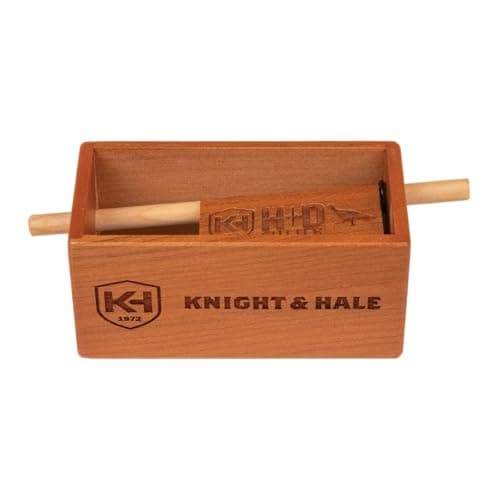
Knight & Hale HD Cutter Push/Pull Call
Push-button call7.6/10The only call here with published stroke lengths: a yelp is 5 to 10 pushes with 1 in strokes, plus clucks, cuts and purrs. Cherry body, hand-tuned, 1-year warranty. Knight & Hale pitches it as a closing call rather than a locator, and says a fighting purr needs two of them.
$34.99Amazon#ad · Price as of November 2, 2026 · Disclosure for the link to Knight & Hale HD Cutter Push/Pull Call
Best classic push-button call
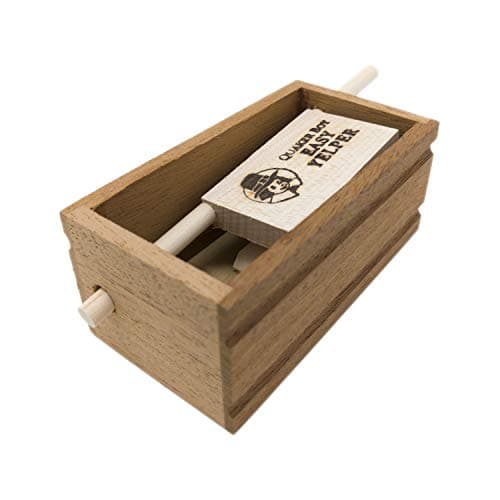
Quaker Boy Easy Yelper
Push-button call6.9/10The classic push-button: mahogany sides, maple striker, birch dowel, stainless spring, and Quaker Boy's line that it is "a favorite of experts and beginners alike." Quaker Boy does not itemize the sounds, and there is no weather claim.
$27.50Amazon#ad · Price as of November 2, 2026 · Disclosure for the link to Quaker Boy Easy Yelper
Best waterproof push-button call
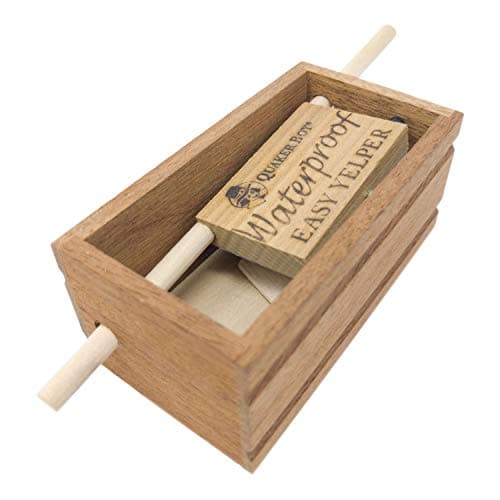
Quaker Boy H2O Easy Yelper
Push-button call7.9/10The same idea built for rain: Quaker Boy says the coating lets it "work in the heaviest rain storms" and that it "requires no chalking." It calls this the easiest call to operate for today's turkey hunter. No published sound list.
$28.25Amazon#ad · Price as of November 2, 2026 · Disclosure for the link to Quaker Boy H2O Easy Yelper
The two-minute kitchen drill
One more rehearsal worth doing before the season: run the call wearing the gloves you will hunt in. A plunger that is easy to feel with a bare finger is a different object through a glove, and gloves are not optional — see what to wear turkey hunting.
How we picked this
Scored on the specs that decide your season
Every pick is read off the maker's own specs, materials and instructions, then scored on a public rubric built around a first-season hunter: the sounds a call is made to produce and how it holds up in rain, a choke's load ratings and thread chart, the weights, pockets and seat heights you carry all morning. Each figure links straight to the page it came from, so you can check any pick in one click.
Scores come from that documented research with fixed bands, and prices come live from Amazon with the date they were checked. Commissions never set a score or decide a pick. The rubric and its bands are published.
Corrections & updates
- First published. Stroke lengths and sound lists from Knight & Hale, Quaker Boy and H.S. Strut product pages; calling cadence from the NWTF.
Questions
Frequently asked
How do you use a push button turkey call?
Hold it in one hand with your index finger on the plunger and push with short, even strokes, letting the spring return it. Knight & Hale publishes a yelp as 5 to 10 pushes using 1 in strokes; a cluck is a single short, light stroke, a purr is a very slow one, and cutting is a burst of fast, uneven strokes. Then stop and listen.
Are push button turkey calls good for beginners?
They are the easiest turkey call to run, which is why makers say so themselves: H.S. Strut advertises its yelper as working “without the large learning curve,” and Knight & Hale calls its push/pull “one of the easiest calls to use” and good for kids and beginners. The trade is one voice and limited volume.
Do you chalk a push button turkey call?
Only if yours is an unsealed wooden call that has gone slick, and then only with nontoxic, oil-free call chalk — never blackboard chalk. Some are built not to need it: Quaker Boy says its H2O Easy Yelper “requires no chalking.” Check the maker's page before you put chalk on anything.
Can you mount a push button call on your gun?
Yes, and it is one of the reasons the call type exists: with the call mounted you can make a sound with the gun already shouldered. Fit it so it does not touch the barrel or interfere with the safety, and practice the stroke with the gun up before opening day.
Why does my push button call squeak?
Too much pressure at too slow a stroke speed is the usual cause, followed by chalk build-up and a damp paddle. Try a lighter, slightly faster stroke first; dry the call slowly at room temperature if it has been rained on; chalk it only if it is a call that takes chalk.
Is a push button call enough on its own?
For a first season, close-range work, yes — but it is quiet and it has one voice. Most hunters pair it with a box or pot call for distance and a locator call for finding birds. That pairing is the starter kit we recommend in best turkey calls for beginners.
Keep reading
Related on Strut & Slate
- Best push-button turkey callsFive of them ranked, including the youth and rain picks.
- How to use a box callThe louder two-handed cousin, for reaching a distant bird.
- How often to call turkeysThe timing that matters more than the technique.
- Best turkey calls for kidsWhy four of the five picks there are push-buttons.
Receipts
Sources
- Knight & Hale — HD Cutter Push/Pull Call product page, SKU KHT0208 (read 2026-09-22)
- Knight & Hale — Warranty Information page (read 2026-09-22)
- Quaker Boy — Easy Yelper product page, #13604 (read 2026-09-22)
- Quaker Boy — H2O Easy Yelper product page, #13608 (read 2026-09-22)
- Quaker Boy — Return Policy page (read 2026-09-22)
- H.S. Strut — Push Button Yelper product page, SKU HS-STR-07056 (read 2026-09-22)
- NWTF — Soft Talk Kills: Why Subtle Calling Consistently Outperforms Loud Yelp Sequences (read 2026-09-22)
- NWTF — Calling Gaffes Turkey Hunters Keep Repeating (read 2026-09-22)
- NWTF — Turkey Call Care (read 2026-09-22)
- NWTF — The Sounds of the Wild Turkey (read 2026-09-22)
Every spec on this page comes from the maker's own product pages and manuals (or a named dealer's copy where the maker's site blocked us), with sound and performance claims attributed to the maker and any third-party observation attributed to whoever made it. Prices come live from Amazon with the date they were checked. Where a maker leaves a figure unpublished, the page says so and that spec earns the lowest band. Read the full method.