The contenders
Side by side
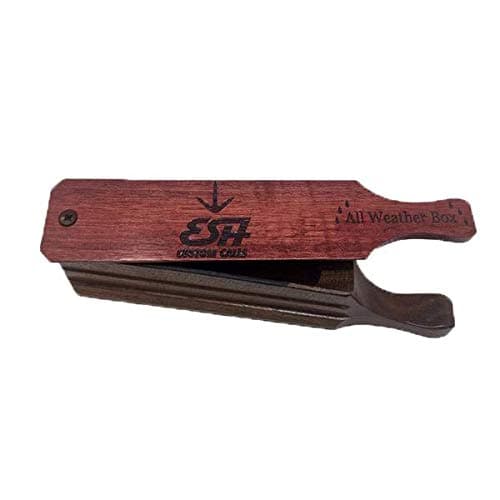
Best box call to start on
ESH Custom Calls All Weather Turkey Box Call
Box call7.9out of 10A walnut-and-purpleheart box with a special coating where the lid and sides meet, which ESH says "keeps you calling in rain or shine," made "for beginner and pro hunters alike."
$89.95Amazon#ad · Price as of November 2, 2026 · Disclosure for the link to ESH Custom Calls All Weather Turkey Box Call
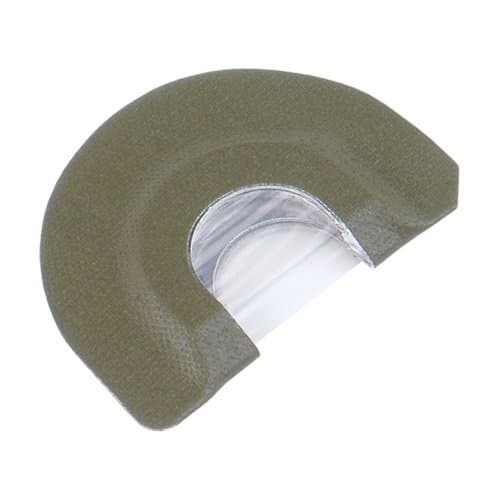
Best mouth call to start on
Primos True Double Turkey Call
Mouth call7.4out of 10A Piggy Back stacked-frame double reed (two super-thin prophylactic reeds, one per frame, held 1/16 in apart so they don't stick) that Primos calls "a very easy call to use" for raspy yelps, clucks, cuts and cackles.
$24.10Amazon#ad · Price as of November 2, 2026 · Disclosure for the link to Primos True Double Turkey Call
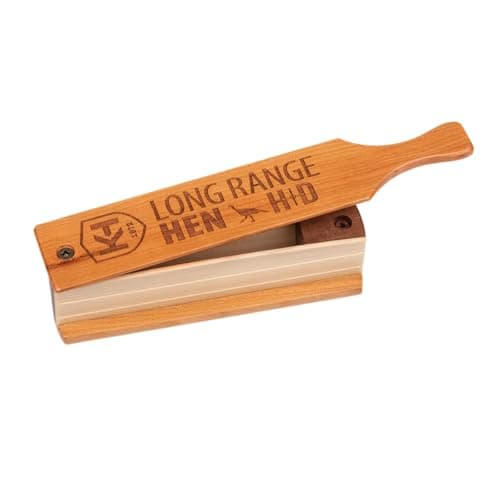
The box with written technique
Knight & Hale HD Long Range Hen Box Call
Box call7.1out of 10A two-sided cherry box with walnut accents that Knight & Hale calls "easy to use, making it a great option for beginners," with step-by-step technique for yelps, clucks, purrs, cutting and a gobble on the product page.
$37.38Amazon#ad · Price as of November 2, 2026 · Disclosure for the link to Knight & Hale HD Long Range Hen Box Call
- Quaker BoyNo image
The other beginner-labeled diaphragm
Quaker Boy Beginner's Double Mouth Call
Mouth call6.5out of 10A two-medium-reed diaphragm that Quaker Boy says is crafted "to help the beginner caller" and calls "easy to use," made in the USA and sold with a call case.
Check price on Amazon#ad · Price as of November 2, 2026 · Disclosure for the link to Quaker Boy Beginner's Double Mouth Call
The verdict
On our published First-Season Score, the two beginner-labeled boxes on this page score 9 of 10 for learning curve and the two beginner-labeled diaphragms score 5. That is not a small gap, and it is not our opinion: it comes from the bands we publish, where a box starts at 8 because the sound is made by wood on wood rather than by your tongue, and a mouth call starts at 4 because it is not. A maker's explicit beginner claim adds a point to either.
Then the gap closes on the other four metrics, and on two of them the diaphragm wins outright. A mouth call scores 9 for weather where an unsealed wood box scores 4, and it scores a flat 10 for carry and vest noise, where every box here scores 5. That is the whole trade in two sentences: the box is easier, the mouth call is more useful once you can run it.
The two at a glance
| What you care about | Box call | Mouth call (diaphragm) |
|---|---|---|
| Time to a believable yelp | An afternoon. ZINK calls friction calls “incredibly beginner-friendly” | Weeks. NWTF: “mouth calling takes a lot of practice and work” |
| Hands | Both. ZINK: “Hold the call base with your off-hand and the lid handle with your dominant hand” | Neither. The gun can already be up |
| Volume at distance | Loud and easy to push; Knight & Hale sells one as a “Long Range Hen” | Varies with your air; a strong caller can be very loud, a new one cannot |
| Rain and dew | A problem unless the maker claims otherwise (ESH, Primos Waterboard, Quaker Boy Hurricane do) | Unaffected; it lives in your mouth |
| Noise on the walk in | Rattles unless banded or strapped | Silent |
| Upkeep | Chalk on a traditional wood box; keep it dry | Rinse it, store it cold, replace it when the latex tires |
Side-by-side specs
Two boxes and two diaphragms, all four labeled for beginners by their own makers. Every value links to the page it came from, and a dash means the maker does not publish it. Notice that no maker here publishes a weight for any of the four.
Which one you can run this month
The box, and it is not close. A box call makes its sound mechanically: chalked wood dragged across chalked wood. ZINK's own instructions reduce running one to a sentence — “Hold the call base with your off-hand and the lid handle with your dominant hand” — and Primos's box-call introduction is barely longer: when you drag the lid across the sideboard, it makes sound. Two of the boxes in our registry go further and build in help. Knight & Hale ships the HD Long Range Hen hand-tuned and pre-chalked and prints the technique for five separate sounds on the page, and the Primos Hook Up uses a magnet to hold the paddle at what Primos calls the perfect angle.
A diaphragm makes its sound with your tongue, your air and the roof of your mouth, and nothing about it is mechanical. The NWTF's own how-to is a list of things to get right at once: the curved back “should fit tightly in the natural curve of your mouth,” the reeds face forward, you keep “constant tongue pressure on the call,” and you “use your diaphragm to force a slow steady stream of air.” Its last instruction is the honest one: “Never get frustrated, mouth calling takes a lot of practice and work.”
That is why both diaphragms here are two-reed calls. The NWTF says to “start with a two-reed call with no cuts in the top reed,” and Primos describes the True Double as “a very easy call to use.” Quaker Boy says its Beginner's Double is crafted from two medium reeds “to help the beginner caller.” If you have already bought a three-reed cutter because it sounded raspy in a video, that is most of your problem; the cuts are explained in mouth call cuts explained.
The step-by-step for each is on its own page: how to use a box call and how to use a mouth call.
The hands problem
This is the only section where the mouth call wins something a box can never take back. A box needs two hands and visible movement, and the moment a gobbler is inside 40 yards and looking for the hen, movement is what gets you caught. The honest sequence with a box is: call while he is behind cover, then put the box down, then get the gun up, then wait and hope he keeps coming without another sound.
A diaphragm removes that whole problem. The call is already in your mouth, the gun is already on your knee, and a soft cluck or a single yelp costs no movement at all. The NWTF's own calling advice is that close in, less is more: “If there's a gobbler in front of you and he's walking to you, no calling at all is the best call,” and when you do need one more note, a mouth call is the only way to make it without lifting anything.
There is a middle route worth knowing about, and it is not a mouth call. A push-button call runs with one hand and very little movement, and the makers of the ones in our registry describe them as the easiest calls to run at all. They are ranked in best push-button turkey calls, and the technique is in how to use a push-button turkey call. For a first season, a box for reaching out and a push-button for close work is a perfectly honest setup while the diaphragm is still in training.
Volume, wind and a bird four ridges away
A box is the loud call. It has a large sounding chamber and a long paddle stroke, and you can lean on it without it breaking up, which is why Knight & Hale brands one of its boxes the HD Long Range Hen and gives it five documented sounds. On a windy morning or across a cut field, that volume is the difference between a bird hearing you and a bird not.
A diaphragm's volume is your volume. A practiced caller can cut hard enough to shock a gobble out of a bird a long way off; a caller in week two usually cannot produce the air pressure to do it, and the sound breaks into a squeak at exactly the moment they push. That is not a flaw in the call, it is the learning curve showing up as volume.
Both calls are also easy to overuse, and the NWTF is blunt about it. Its calling-gaffes piece describes hunters “just making every sound they can think of without trying to communicate to the turkey,” and its public-land guide warns that keeping birds gobbling “attracts other hunters.” How much to call, and when to stop, is in how often to call turkeys.
Rain, and what it does to each
A traditional wood box goes quiet when it gets wet, and three makers in our registry answer that directly: ESH says its coating where the lid and sides meet “keeps you calling in rain or shine,” Primos says the Waterboard “works wet or dry,” and Quaker Boy calls the Hurricane waterproof. A box with no weather claim scores 4 of 10 on our weather metric, and that single number is most of the gap between the top boxes and the rest in our box call ranking.
A mouth call does not care. It lives in a wet mouth by design, which is why every diaphragm in our registry scores 9 for weather. On the kind of drizzly morning covered in turkey hunting in the rain, the diaphragm is the call that is definitely still working — and that is a real argument for pushing through the practice before spring. The full wet-weather lineup across call types is in best waterproof turkey calls.
Chalk, rubber bands and the refrigerator
Both calls need upkeep, and it is completely different upkeep.
A traditional wood box wants chalk on the underside of the lid — nontoxic and oil-free, per Lynch's own instructions — and it wants to stay out of the heat and the damp. A waterproof box is the exception; Quaker Boy says the Hurricane never needs sanding or chalking. It also needs silencing for the walk in: a rubber band, a silencer strap, or a detachable paddle. The whole routine, including the three things that permanently ruin a box, is in box call chalk and care.
A mouth call wants hygiene and cold. The NWTF's call-care guidance is to “wash mouth diaphragms with warm water to remove latex residue,” soak them in a one-to-one mouthwash and water solution, pat them dry, and “keep your mouth calls in a plastic case or bag in the refrigerator.” Latex is a consumable: a diaphragm you leave in a hot truck will be dead before the season is.
What each one costs you
We do not print prices we cannot verify, and the buy buttons on this page show today's. What we can say is the shape of the spend, because it is different in a way that matters.
A box call is one purchase that lasts years. A custom walnut box costs more than a mass-produced one and does not make you a better caller; the NWTF's own beginner guidance is that “It doesn't have to be the most expensive box or pot call, just a good quality call will do the trick.”
Mouth calls are cheap individually and bought repeatedly: the latex stretches, the tape loosens, and most hunters end up owning several cuts. That is why the sampler packs exist, and why two of them score well in our beginner mouth call picks. The multi-call starter packs that bundle a box, a pot and a diaphragm together are ranked in best turkey call starter kits — with the honest caveat that two calls you chose yourself usually beat four you did not.
The honest answer: both, in this order
Week one, buy a box and learn a yelp, a cluck and a cut on it. You will have a call you can hunt with before the month is out, and the NWTF notes that beginners usually find a box the easiest call to get a consistent sound from.
Week one, also buy one two-reed diaphragm and drive around with it in your mouth. Not three cuts, not a pack of six — one, with no cuts in the top reed, exactly as the NWTF recommends. Practice on the commute where nobody has to hear it.
By spring you will have a box that reaches out and a diaphragm that finishes birds, and the second one will have cost you almost nothing but time. If you want a third call, make it a pot call rather than another diaphragm: box call vs slate call covers that pairing, our WoodHaven Anodized Ninja review is the close read on the top-ranked pot call, and best turkey calls for beginners ranks every type together.
In detail
The contenders, in full
Best box call to start on
ESH Custom Calls All Weather Turkey Box Call
A walnut-and-purpleheart box with a special coating where the lid and sides meet, which ESH says "keeps you calling in rain or shine," made "for beginner and pro hunters alike."
Spec sheetEvery row sourced to the maker
How the 7.9 score breaks down
- Beginner learning curve (30%)
- 9
- Sound range (20%)
- 8
- Weather tolerance (20%)
- 9
- Build & materials (15%)
- 7
- Carry & vest noise (15%)
- 5
What the specs support
- ESH says the coating "keeps you calling in rain or shine."
- Five sounds listed, including the fly-down cackle (per ESH).
- Made "for beginner and pro hunters alike" (per ESH).
- Walnut and purpleheart hardwoods.
Where it falls short
- No published warranty; the "lifetime sealer" is a finish, not a warranty.
- No dimensions or weight published.
- No lid band or silencer is listed for quiet carry.
Skip this if…
…you want a call backed by a published warranty; ESH lists none, only a 14-day window to report damaged or defective items.
#ad · Price as of November 2, 2026 · Disclosure for the link to ESH Custom Calls All Weather Turkey Box Call
Best mouth call to start on
Primos True Double Turkey Call
A Piggy Back stacked-frame double reed (two super-thin prophylactic reeds, one per frame, held 1/16 in apart so they don't stick) that Primos calls "a very easy call to use" for raspy yelps, clucks, cuts and cackles.
Spec sheetEvery row sourced to the maker
How the 7.4 score breaks down
- Beginner learning curve (30%)
- 5
- Sound range (20%)
- 7
- Weather tolerance (20%)
- 9
- Build & materials (15%)
- 8
- Carry & vest noise (15%)
- 10
What the specs support
- Primos calls it "a very easy call to use" and names four sounds: raspy yelps, clucks, cuts and cackles.
- The stacked frames hold the two reeds 1/16 in apart so they don't stick together (per Primos).
- Reeds are named as super-thin prophylactic, and a pin box comes in the package.
- Covered by Primos's 1-year defect warranty.
Where it falls short
- Primos publishes no cut name, so it is harder to place in a cut-by-cut comparison than the Zink or WoodHaven calls.
- Purrs and kee-kees are not on Primos's sound list.
- No frame dimensions or weight published.
Skip this if…
…you want a call with a named cut (batwing, V, ghost) to follow a cut-specific guide; Primos does not name this call's cut.
#ad · Price as of November 2, 2026 · Disclosure for the link to Primos True Double Turkey Call
The box with written technique
Knight & Hale HD Long Range Hen Box Call
A two-sided cherry box with walnut accents that Knight & Hale calls "easy to use, making it a great option for beginners," with step-by-step technique for yelps, clucks, purrs, cutting and a gobble on the product page.
Spec sheetEvery row sourced to the maker
How the 7.1 score breaks down
- Beginner learning curve (30%)
- 9
- Sound range (20%)
- 8
- Weather tolerance (20%)
- 4
- Build & materials (15%)
- 8
- Carry & vest noise (15%)
- 5
What the specs support
- Knight & Hale says it is "easy to use, making it a great option for beginners."
- Five sounds, each with written technique on the product page.
- Hand-tuned and pre-chalked out of the package (per Knight & Hale).
- 1-year Knight & Hale warranty.
Where it falls short
- The gobble technique needs a rubber band that Knight & Hale doesn't list as included.
- No weather claim for this chalked wood box.
- No lid band or silencer is listed for quiet carry.
Skip this if…
…you want a box you can leave unchalked in the rain; this is a traditional pre-chalked wood box with no weather claim.
#ad · Price as of November 2, 2026 · Disclosure for the link to Knight & Hale HD Long Range Hen Box Call
The other beginner-labeled diaphragm
Quaker Boy Beginner's Double Mouth Call
A two-medium-reed diaphragm that Quaker Boy says is crafted "to help the beginner caller" and calls "easy to use," made in the USA and sold with a call case.
Spec sheetEvery row sourced to the maker
How the 6.5 score breaks down
- Beginner learning curve (30%)
- 5
- Sound range (20%)
- 4
- Weather tolerance (20%)
- 9
- Build & materials (15%)
- 6
- Carry & vest noise (15%)
- 10
What the specs support
- Quaker Boy says outright that the two medium reeds are set "to help the beginner caller."
- Only two reeds, so there is less latex to control than on the three-reed calls in this lineup.
- Ships with a call case (per Quaker Boy).
- Made in the USA (per Quaker Boy).
Where it falls short
- Quaker Boy does not list which turkey sounds it makes or name the reed cut.
- No frame material, latex thickness or warranty is published on the product page.
Skip this if…
…you already yelp on a diaphragm and want heavy rasp for loud cutting; this is sold as a beginner's call, and WoodHaven markets its three-reed Ninja V as "very raspy" for that job.
#ad · Price as of November 2, 2026 · Disclosure for the link to Quaker Boy Beginner's Double Mouth Call
How we picked this
Scored on the specs that decide your season
Every pick is read off the maker's own specs, materials and instructions, then scored on a public rubric built around a first-season hunter: the sounds a call is made to produce and how it holds up in rain, a choke's load ratings and thread chart, the weights, pockets and seat heights you carry all morning. Each figure links straight to the page it came from, so you can check any pick in one click.
Scores come from that documented research with fixed bands, and prices come live from Amazon with the date they were checked. Commissions never set a score or decide a pick. The rubric and its bands are published.
Corrections & updates
- First published. Maker claims from ESH, Knight & Hale, Primos and Quaker Boy product pages; learning, care and calling-volume guidance from the NWTF and ZINK's published instructions.
Questions
Frequently asked
Is a box call or a mouth call better for a beginner?
A box call, clearly. ZINK says friction calls, which include box calls, “are incredibly beginner-friendly,” and the two beginner-labeled boxes on this page score 9 of 10 on our learning-curve metric against 5 for the two beginner-labeled diaphragms. The NWTF's own mouth-call guide ends with “mouth calling takes a lot of practice and work.”
Why do experienced hunters use mouth calls then?
Hands. A diaphragm is the only call you can run with the shotgun already mounted, which is exactly the situation at 25 yards with a gobbler looking for a hen. It also does not care about rain, and it makes no noise in the vest. The cost of all that is a learning curve measured in weeks.
Can I use a box call with a turkey close in?
You can, but it costs movement, and movement is what loses close birds. Call while the bird is behind cover, then put the box down and get the gun up. The NWTF's advice for a gobbler already walking toward you is that “no calling at all is the best call.” If you want a call for close work that needs one hand and almost no motion, a push-button is the honest answer.
Does a box call work in the rain?
Only if its maker says so. ESH says its All Weather box “keeps you calling in rain or shine,” Primos says the Waterboard “works wet or dry,” and Quaker Boy calls the Hurricane waterproof. A plain wood box with no weather claim should stay dry. A mouth call is unaffected either way.
Which mouth call should a beginner buy first?
A two-reed with no cuts in the top reed, which is what the NWTF recommends starting on. The Primos True Double fits that description and Primos calls it “a very easy call to use”; Quaker Boy's Beginner's Double is two medium reeds set “to help the beginner caller.” Buy one, not a pack of cuts.
How long does it take to learn a mouth call?
No maker or agency publishes a number, so we will not invent one. What the NWTF publishes is the expectation: a lot of practice and work, and a warning not to get frustrated. The practical answer most hunters land on is weeks of daily practice to a usable yelp, which is why the box call exists in your vest in the meantime.
How do you store each call between hunts?
A box call: dry, out of the heat, with the lid banded or strapped so it does not rattle, and chalked if it is a traditional wood box. A mouth call: rinsed, patted dry, and kept in a case or bag in the refrigerator, which is the NWTF's own guidance for keeping latex alive.
Keep reading
Related on Strut & Slate
- Box call vs slate callThe other half of the box-call question: volume against subtlety.
- Best box callsSeven boxes ranked, including the three built for beginners.
- Best mouth calls for beginnersWhich diaphragm to start on, and which cuts to leave alone.
- Best turkey calls for beginnersEvery call type ranked together for a first season.
Receipts
Sources
- ESH Custom Calls (Outdoor Hunting Lab store) — ALL WEATHER Turkey Box Call product page, SKU AW-BOX-CALL2 (read 2026-09-22)
- ESH Custom Calls (Outdoor Hunting Lab store) — Refund Policy page (read 2026-09-22)
- Knight & Hale — HD Long Range Hen Box Call product page, SKU KHT0207 (read 2026-09-22)
- Knight & Hale — Warranty Information page (read 2026-09-22)
- Primos — Hook Up Magnetic Turkey Call product page, SKU 259 (read 2026-09-22)
- Quaker Boy — Hurricane Box Call product page, #13641 (read 2026-09-22)
- Primos — Waterboard Turkey Box Call product page, SKU PS257 (read 2026-09-22)
- Lynch Since 1940 — Lynch Call Instructions page (read 2026-09-22)
- Primos — True Double Turkey Call product page, SKU PS108 (read 2026-09-22)
- Primos — Warranty page, general warranty coverage (read 2026-09-22)
- Quaker Boy — Beginners Double mouth call product page, SKU #11100 (read 2026-09-22)
- ZINK Calls — Frequently Asked Questions (read 2026-09-22)
- NWTF — Mouth Call Madness (read 2026-09-22)
- NWTF — Turkey Hunting 101 (read 2026-09-22)
- NWTF — Turkey Call Care (read 2026-09-22)
- NWTF — Calling Gaffes Turkey Hunters Keep Repeating (read 2026-09-22)
- NWTF — 10 Commandments Of Public Land Turkey Hunting (read 2026-09-22)
- Primos — An Introduction to Box Calls (read 2026-09-22)
Every spec on this page comes from the maker's own product pages and manuals (or a named dealer's copy where the maker's site blocked us), with sound and performance claims attributed to the maker and any third-party observation attributed to whoever made it. Prices come live from Amazon with the date they were checked. Where a maker leaves a figure unpublished, the page says so and that spec earns the lowest band. Read the full method.